
Beyond where orders sit, traders read the balance of pressure and the cost of moving the market. Order book imbalance shows which side is heavier, cumulative volume delta tracks whether buyers or sellers are winning over time, and market impact measures the price you push by trading. These order flow concepts explain why a market drifts and why your own large order can work against you. Here is how each one reads.
Order book imbalance
Order book imbalance compares the resting orders on each side of the book. If far more buy orders are stacked below the price than sell orders above it, the book is buy-heavy, hinting at more support than resistance, and vice versa. Some platforms show this as an imbalance indicator or a ratio. It is a snapshot of intent, not a promise, because resting orders can be pulled, but a persistent imbalance often precedes a drift in that direction.
Cumulative volume delta
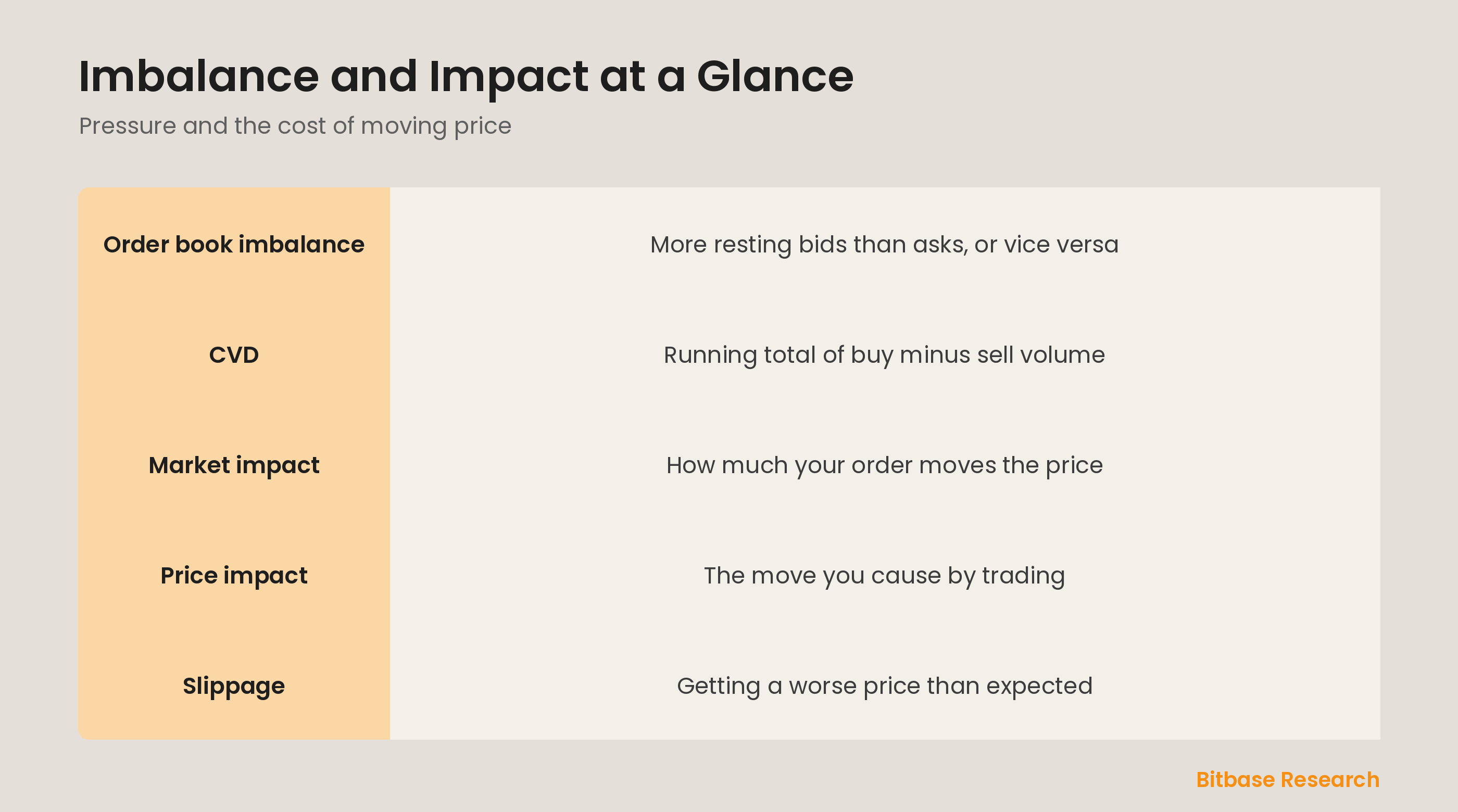
Cumulative volume delta, or CVD, tracks executed trades rather than resting orders. It keeps a running total of aggressive buying minus aggressive selling: every market buy adds, every market sell subtracts. A rising CVD means buyers are lifting offers more than sellers are hitting bids, real pressure that has already traded. Watching CVD against price is powerful: if price stalls while CVD keeps rising, buyers are being absorbed, which can hint at a coming reversal.
Market impact and price impact
When you place a large order, you move the price yourself, and that is market impact. Price impact is the size of that self-inflicted move: a big market buy eats through the offers, lifting the price as it fills. The larger your order relative to the book's depth, the greater the impact. This is why splitting large orders and using tools like TWAP matter, since they spread the impact instead of paying it all at once.
Price impact versus slippage
Price impact and slippage are related but not the same. Price impact is the move you cause by trading; slippage is the gap between the price you expected and the price you actually got. Your own impact is one cause of slippage, but slippage also comes from the market moving between your decision and your fill, and from a thin book. Understanding both helps you size orders so you do not push the price against yourself or get filled far from your target.
The bottom line
Order book imbalance shows which side of the resting book is heavier, CVD tracks whether aggressive buyers or sellers are winning in actual trades, and market impact measures how much your own order moves the price. Price impact is that self-caused move, and slippage is the resulting gap between expected and actual price. Reading pressure and impact together lets you gauge direction and size your trades to avoid moving the market against yourself. To keep learning the fundamentals, follow more from Bitbase Academy.
Disclaimer: This article is educational content from Bitbase Academy, provided for information only. It does not constitute investment, trading, tax, or financial advice. Crypto assets are volatile; assess your own risk. Written as of June 2026; refer to the latest official information.
References
[1] Investopedia, "Order Book: Definition, How It Works, and Key Parts" investopedia.com
[2] Investopedia, "Slippage: What It Means in Finance, With Examples" investopedia.com
[3] Investopedia, "Liquidity: Definition, Example, and How It Works" investopedia.com