Once you are in a trade, two questions decide the outcome: where do you take profit, and where do you cut a loss? Take-profit and stop-loss orders answer each, and an OCO order links them so that whichever happens first automatically cancels the other. Together they let you set an exit plan and walk away. Here is how these three order tools work and how they fit together.
Take-profit and stop-loss
A take-profit order closes your position for a gain when the price reaches a target you set above your entry. A stop-loss does the opposite: it closes the position to cap your loss if the price falls to a level you set below your entry. One locks in profit, the other limits damage. Setting both before emotion takes over is the core of a disciplined exit.
What an OCO order is
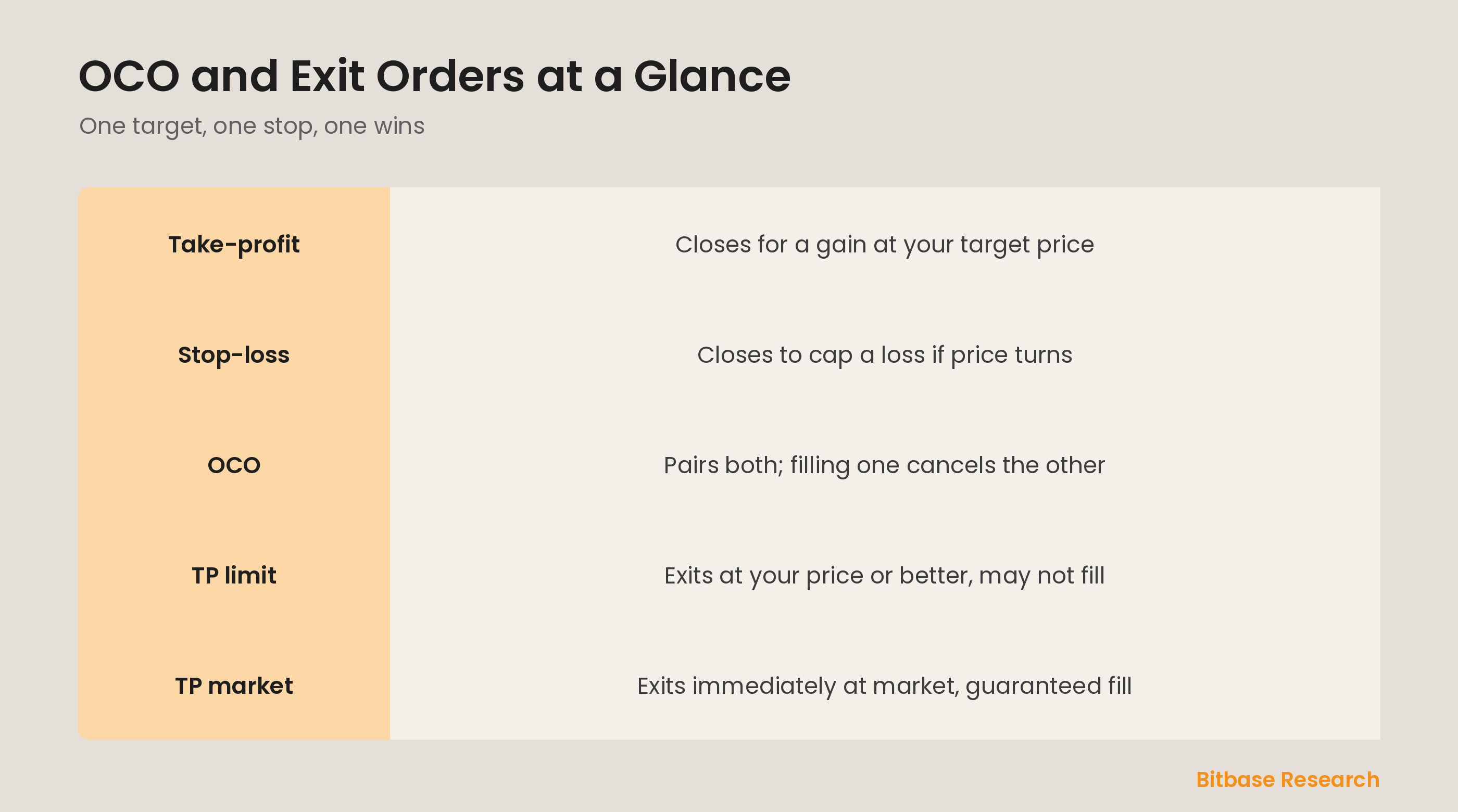
An OCO, short for one-cancels-the-other, bundles two orders so that when one executes, the exchange automatically cancels the other. For an open position, you place a take-profit above and a stop-loss below as an OCO pair. If the price rises to your target, the take-profit fills and the stop-loss is cancelled; if it falls to your stop, the reverse happens. You never end up accidentally holding a leftover order.
Take-profit limit vs market
Your exit can be a limit or a market order, and the choice is a trade-off. A take-profit limit exits at your price or better, protecting the price you get, but it may not fill if the market gaps past it. A take-profit market exits immediately at whatever price is available, guaranteeing the fill but not the price. The same choice applies to stops. Pick based on whether certainty of price or certainty of exit matters more.
Using them well
The power of these tools is that they let you plan an exit in advance and enforce it without watching the screen. Set your take-profit and stop-loss as an OCO right after entering, so a target and a safety net are always in place. Do not move a stop wider just because the price is testing it; that turns a small planned loss into a large unplanned one. Let the OCO do its job.
The bottom line
A take-profit closes a trade for a gain at your target, a stop-loss caps a loss if price turns, and an OCO links the two so filling one cancels the other. Each exit can be a limit order for price control or a market order for a guaranteed fill. Set both as an OCO when you enter, respect them, and your exits become a plan you decided calmly rather than a panic in the moment. To keep learning the fundamentals, follow more from Bitbase Academy.
Disclaimer: This article is educational content from Bitbase Academy, provided for information only. It does not constitute investment, trading, tax, or financial advice. Crypto assets are volatile; assess your own risk. Written as of June 2026; refer to the latest official information.
References
[1] Investopedia, "One Cancels the Other (OCO) Order: Definition and Use in Trading" investopedia.com
[2] Investopedia, "Take-Profit Order (TP): Definition, Use in Trading, and Example" investopedia.com
[3] Investopedia, "Stop-Loss Order: Definition, How It Works, and Examples" investopedia.com