One of the simplest ways to turn moving averages into actual buy and sell signals is to watch two of them cross. When a faster average crosses a slower one, it marks a shift in momentum, and two of these crossovers, the golden cross and the death cross, are famous enough to make financial headlines. Here is how crossovers work, what those two named crosses mean, and why they are not as magical as they sound.
How a crossover works
A crossover system uses two moving averages of different lengths: a shorter, faster one that reacts quickly, and a longer, slower one that shows the broader trend. As long as the fast line stays above the slow line, the shorter-term momentum is stronger than the longer-term average, a broadly bullish condition. When the fast line crosses to the other side, it signals that the balance of momentum has shifted, which traders treat as a potential trade signal.
The golden cross
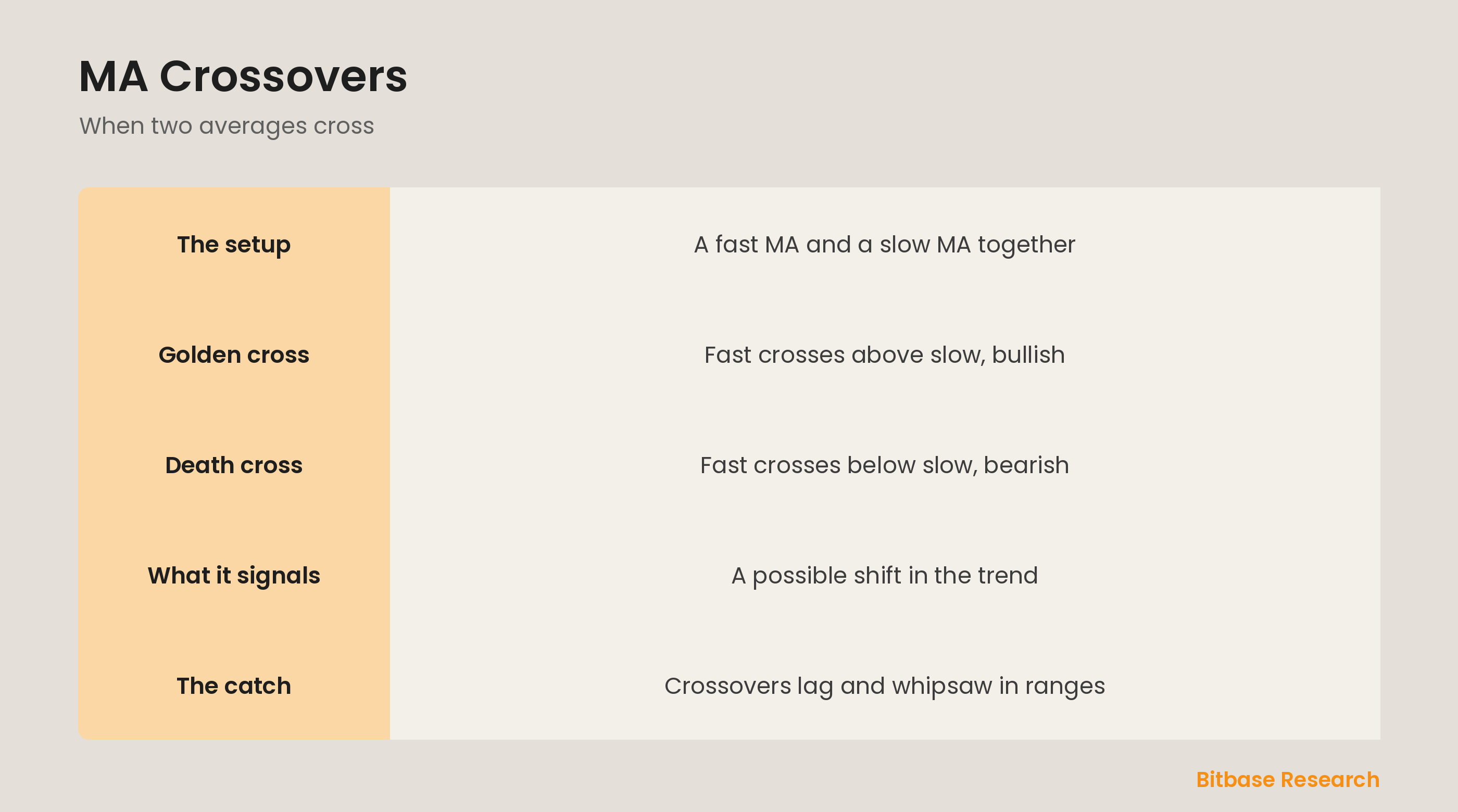
A golden cross happens when a faster moving average crosses up through a slower one, classically the 50-period rising above the 200-period. It signals that shorter-term momentum has turned up strongly enough to overtake the long-term trend, and it is widely read as a bullish sign that a major uptrend may be beginning. Because it involves long averages, a golden cross is a slow, big-picture signal, often confirming a trend that is already underway rather than calling a bottom.
The death cross
A death cross is the bearish opposite: a faster moving average crossing down through a slower one, classically the 50-period falling below the 200-period. It signals that shorter-term momentum has turned down enough to drag below the long-term trend, and it is read as a warning that a major downtrend may be setting in. Like the golden cross, it is a slow signal built from long averages, so it tends to confirm a decline rather than predict its start.
The limits of crossovers
Crossovers have a real weakness: they lag. Because they are built from averages of past prices, the cross only happens after a move is well underway, so you get in or out late. Worse, in a sideways, choppy market, the two averages cross back and forth repeatedly, generating a string of false signals called whipsaws that can rack up losses. Crossovers work best in strongly trending markets and poorly in ranging ones, so context and confirmation still matter.
The bottom line
A moving average crossover uses a fast and a slow average, signaling a shift when the fast one crosses the slow one. A golden cross, fast crossing above slow, is bullish, while a death cross, fast crossing below, is bearish, both famous when built from the 50 and 200 periods. But crossovers lag because they rely on past prices, and they whipsaw in ranging markets, so they work best in strong trends and should be paired with other confirmation. To keep learning the fundamentals, follow more from Bitbase Academy.
Disclaimer: This article is educational content from Bitbase Academy, provided for information only. It does not constitute investment, trading, tax, or financial advice. Crypto assets are volatile; assess your own risk. Written as of June 2026; refer to the latest official information.
References
[1] Investopedia, "Golden Cross Pattern: Definition and Example" investopedia.com
[2] Investopedia, "Death Cross: Definition, How It Works, and Examples" investopedia.com
[3] Investopedia, "Moving Average (MA): Purpose, Uses, Formula, and Examples" investopedia.com