Every time you buy or sell instantly, someone is on the other side ready to trade. Often that someone is a market maker, a firm or trader whose job is to keep the order book full by quoting both a buy and a sell price. They earn the spread, they carry real risk, and their behavior explains why spreads widen in a panic and tighten in calm. Here is how market makers, spreads, and the book's refresh rate fit together.
Liquidity providers and market makers
A liquidity provider is anyone who posts resting limit orders that others can trade against, adding depth to the book. A market maker is a specialized liquidity provider that continuously quotes both sides at once, offering to buy at a bid and sell at an offer around the current price. By always standing ready on both sides, market makers ensure that when you send a market order, there is something to fill it, which is what makes a market liquid and smooth.
The spread as their pay
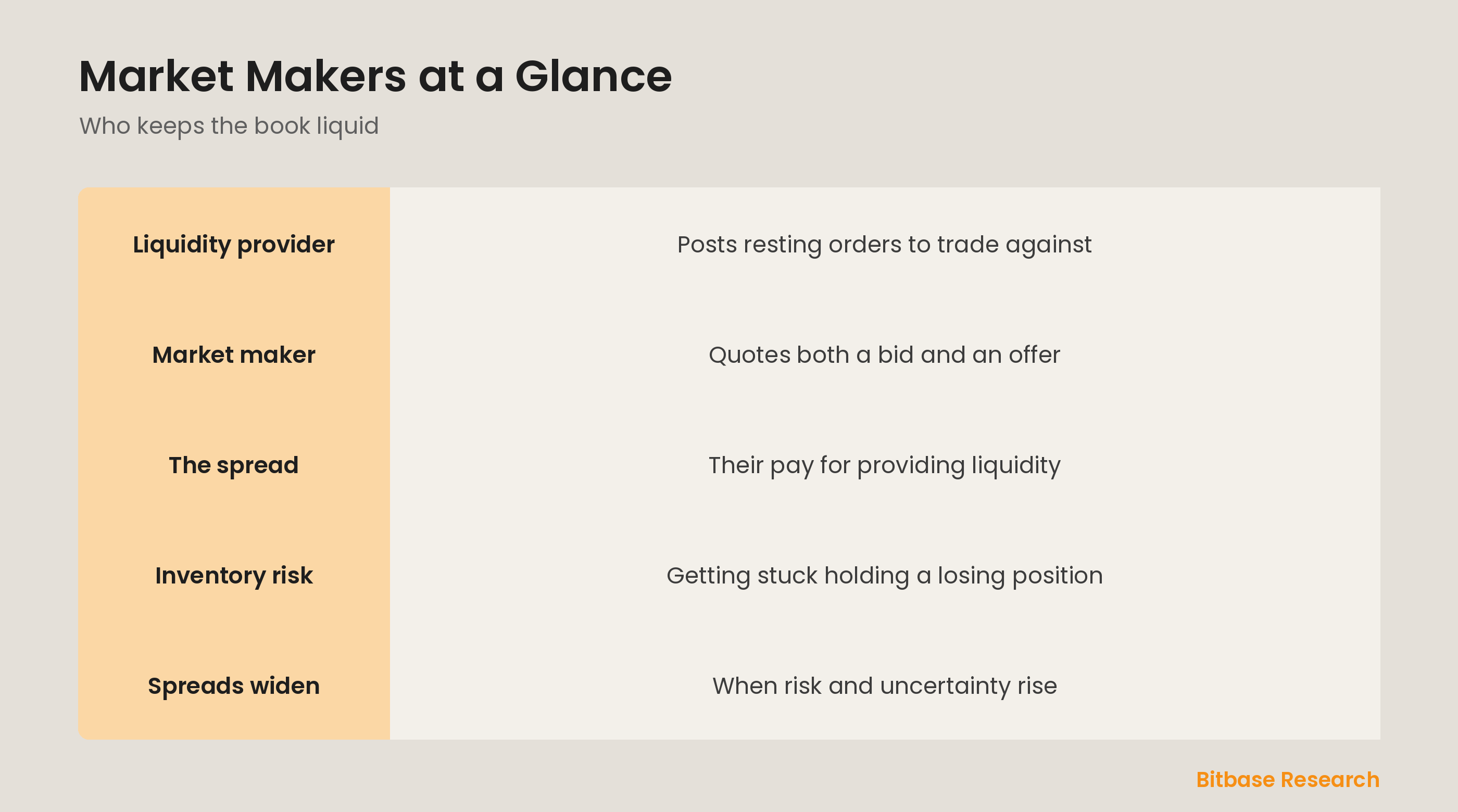
Market makers are not charities; the spread is how they get paid. They buy at the bid and sell at the offer, pocketing the small difference on each round trip. In a busy, competitive market with many makers, spreads are tight because they compete to offer the best prices. The spread is therefore both a cost to you as a taker and the reward that motivates makers to provide the liquidity you rely on.
Inventory risk and widening spreads
A market maker who buys from sellers and sells to buyers ends up holding an inventory that can move against them. If they buy a coin and the price then drops before they can sell it, they take a loss; that is inventory risk. When markets get volatile or uncertain, this risk rises, so makers widen their spreads to compensate, or pull their quotes altogether. That is why spreads blow out during crashes and news shocks, right when you least want them to.
Refresh rate and spread compression
The order book updates constantly as makers post, cancel, and adjust their quotes; that pace is the refresh rate. Fast, active markets refresh quickly, with quotes shifting many times a second. In calm, competitive conditions, spreads compress as makers tighten their prices to win flow. Reading spreads and their movement tells you the market's mood: tight and stable means confident makers and deep liquidity, while sudden widening warns that liquidity is thinning and risk is up.
The bottom line
Market makers keep the order book liquid by continuously quoting both a bid and an offer, earning the spread as their pay for standing ready on both sides. They carry inventory risk, and when volatility or uncertainty rises, they widen spreads or pull quotes to protect themselves. The book's refresh rate reflects how fast they adjust. Watching spreads compress or widen gives you a live read on liquidity and the market's confidence. To keep learning the fundamentals, follow more from Bitbase Academy.
Disclaimer: This article is educational content from Bitbase Academy, provided for information only. It does not constitute investment, trading, tax, or financial advice. Crypto assets are volatile; assess your own risk. Written as of June 2026; refer to the latest official information.
References
[1] Investopedia, "Market Maker: Definition, How They Make Money, and Key Roles" investopedia.com
[2] Investopedia, "Bid-Ask Spread: Definition, Meaning, and How It Works" investopedia.com
[3] Investopedia, "Liquidity: Definition, Example, and How It Works" investopedia.com