A large order is a problem: place it all at once and you move the market against yourself, revealing your hand and paying a worse average price. Iceberg, hidden, TWAP, and VWAP orders are the professional tools for solving this. Two of them hide your size; two of them slice your order across time. All aim to reduce market impact. Here is what each does and when to reach for it.
Iceberg and hidden orders
An iceberg order shows only a small tip of your true size on the order book while keeping the rest hidden beneath the surface; as each visible piece fills, the next slice appears. A hidden order goes further and shows nothing at all. Both exist so a large order does not scare the market by revealing its full size, which could cause others to trade against it. The trade-off is that hidden liquidity usually gives up queue priority to visible orders.
TWAP orders
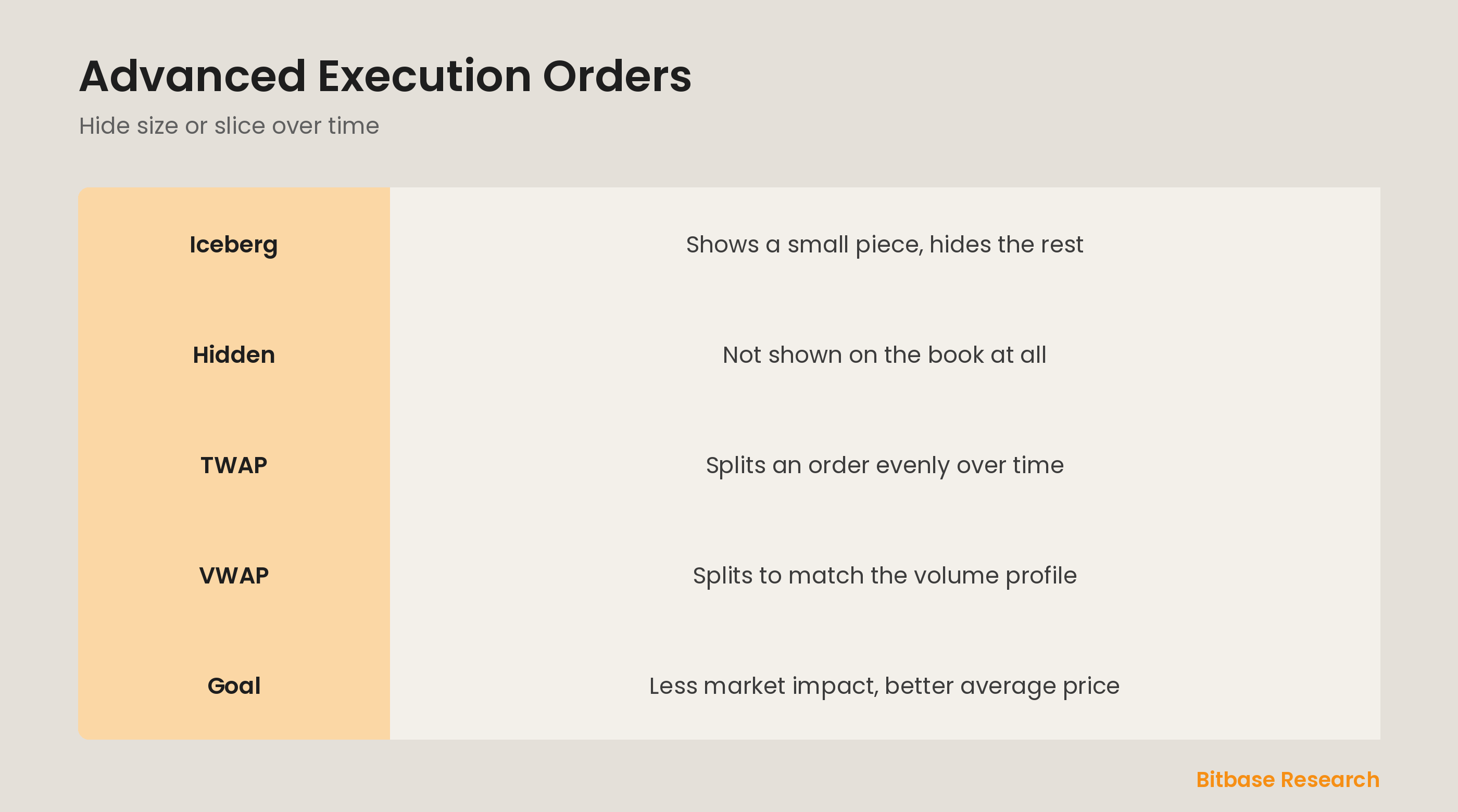
A TWAP, or time-weighted average price order, takes a big order and splits it into smaller pieces released evenly over a set period. Instead of buying everything now, you buy a little each minute for an hour, aiming for an average price close to the market's average over that window. TWAP is simple and predictable, and it works well when you want to spread an order across time without trying to outsmart the volume pattern.
VWAP orders
A VWAP, or volume-weighted average price order, is smarter about timing. Rather than slicing evenly, it releases more of the order when trading volume is high and less when it is thin, trying to match the market's volume-weighted average price. Because it trades more when liquidity is deep, it tends to cause less impact than a naive schedule. Traders use VWAP as both an execution method and a benchmark for judging how good a fill was.
When to use each
Reach for iceberg or hidden orders when concealing your size matters more than queue priority, such as accumulating a large position quietly. Use TWAP when you simply want to average into a position steadily over time. Use VWAP when you want your execution to track the market's natural volume rhythm and minimize impact on a large order. All four are about the same goal: getting a big order done without paying a big price for being big.
The bottom line
Iceberg and hidden orders conceal your true size, showing little or nothing on the book. TWAP slices an order evenly across time, while VWAP slices it to follow the volume profile. Each reduces the market impact and information leakage that come with trading large, helping you achieve a better average price. Choose based on whether your priority is hiding size or intelligently spreading the order over time. To keep learning the fundamentals, follow more from Bitbase Academy.
Disclaimer: This article is educational content from Bitbase Academy, provided for information only. It does not constitute investment, trading, tax, or financial advice. Crypto assets are volatile; assess your own risk. Written as of June 2026; refer to the latest official information.
References
[1] Investopedia, "Iceberg Order: Definition, How They Work, Pros and Cons" investopedia.com
[2] Investopedia, "Volume-Weighted Average Price (VWAP): Definition and Calculation" investopedia.com
[3] Investopedia, "Order Book: Definition, How It Works, and Key Parts" investopedia.com