The head and shoulders is one of the most famous reversal patterns, and for good reason: its shape tells a clear story of an uptrend running out of strength. Once you see the three peaks and the line beneath them, you can read the moment buyers lose control. It also has an upside-down twin that marks bottoms. Here is how the head and shoulders forms, what the neckline does, and how the inverse version works.
The shape of the pattern
A head and shoulders forms at the top of an uptrend and has three peaks. The first, the left shoulder, is a high followed by a pullback. The second, the head, pushes to a higher high, then pulls back again. The third, the right shoulder, rises to roughly the height of the left shoulder but fails to reach the head, forming a lower peak. This sequence, high, higher, then lower, is the visual signature of buyers gradually losing strength.
What the shape means
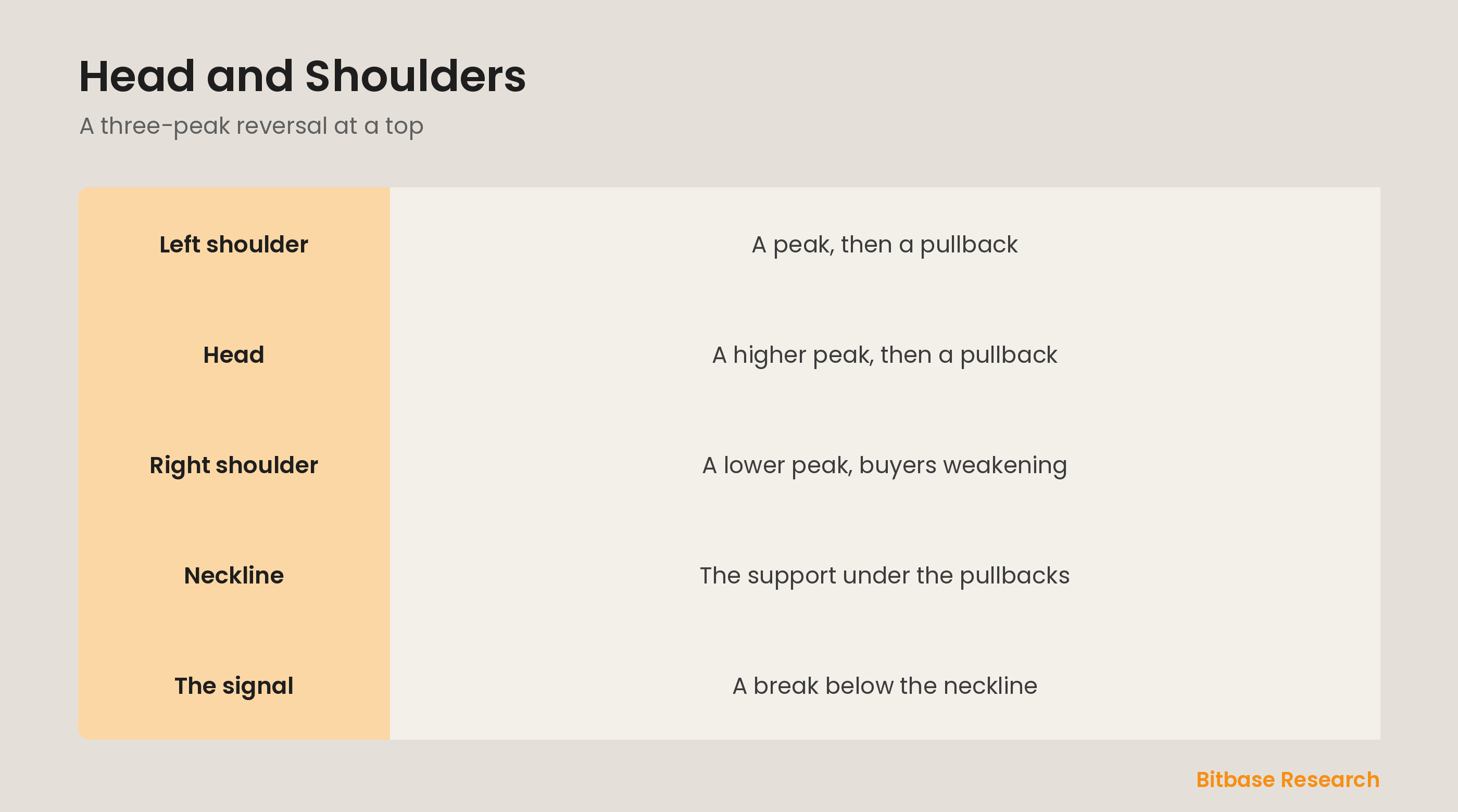
The story behind the shape is a trend running out of steam. Through the left shoulder and head, buyers still push price to new highs. But the right shoulder failing to exceed the head shows they can no longer make progress; each rally is weaker. The pattern captures the transition from an uptrend, where buyers dominate, to a potential downtrend, as their control fades. It is essentially a break of structure dressed in a recognizable shape.
The neckline
The key level in a head and shoulders is the neckline, a line drawn across the lows of the pullbacks between the peaks, the troughs on either side of the head. The neckline acts as the support holding the whole pattern up. As long as price stays above it, the pattern is only potential; the reversal is not confirmed until price decisively breaks below the neckline, which is the trigger the pattern is built around.
The inverse head and shoulders
The pattern also appears upside down at the bottom of a downtrend, called an inverse head and shoulders. It has three troughs, a low, a lower low as the head, and a higher low as the right shoulder, showing sellers losing strength. Its neckline runs across the peaks of the bounces, and a break above it signals a potential reversal from downtrend to uptrend. The inverse version marks bottoms just as the standard version marks tops.
The bottom line
A head and shoulders is a reversal pattern at a top made of three peaks: a left shoulder, a higher head, and a lower right shoulder, showing buyers losing strength. The neckline, drawn across the pullback lows, is the key support, and the reversal is confirmed only when price breaks below it. The inverse head and shoulders is the mirror image at a bottom, confirmed by a break above its neckline, marking a potential turn upward. To keep learning the fundamentals, follow more from Bitbase Academy.
Disclaimer: This article is educational content from Bitbase Academy, provided for information only. It does not constitute investment, trading, tax, or financial advice. Crypto assets are volatile; assess your own risk. Written as of June 2026; refer to the latest official information.
References
[1] Investopedia, "Head and Shoulders Pattern: Definition, How To Trade" investopedia.com
[2] Investopedia, "Trend: Definition, Types, Examples, and Uses in Trading" investopedia.com
[3] Investopedia, "Breakout: What It Means, Examples, and How To Trade" investopedia.com