Grid trading is a systematic strategy that turns a choppy, sideways market from an annoyance into an opportunity. Instead of predicting direction, it places a ladder of buy and sell orders at set intervals and lets the market's back-and-forth do the work, buying dips and selling rallies automatically. Often run by bots, it is popular in crypto for range-bound conditions. Here is how grid trading works and where its risk lies.
The core idea
Grid trading places a series of buy and sell orders spaced evenly by price across a chosen range, forming a grid. Buy orders sit at intervals below the current price and sell orders at intervals above it. As price oscillates up and down within the range, it repeatedly crosses these levels, filling orders. Each buy that fills lower gets paired with a sell that fills higher, capturing a small profit on each swing, over and over.
How it profits from oscillation
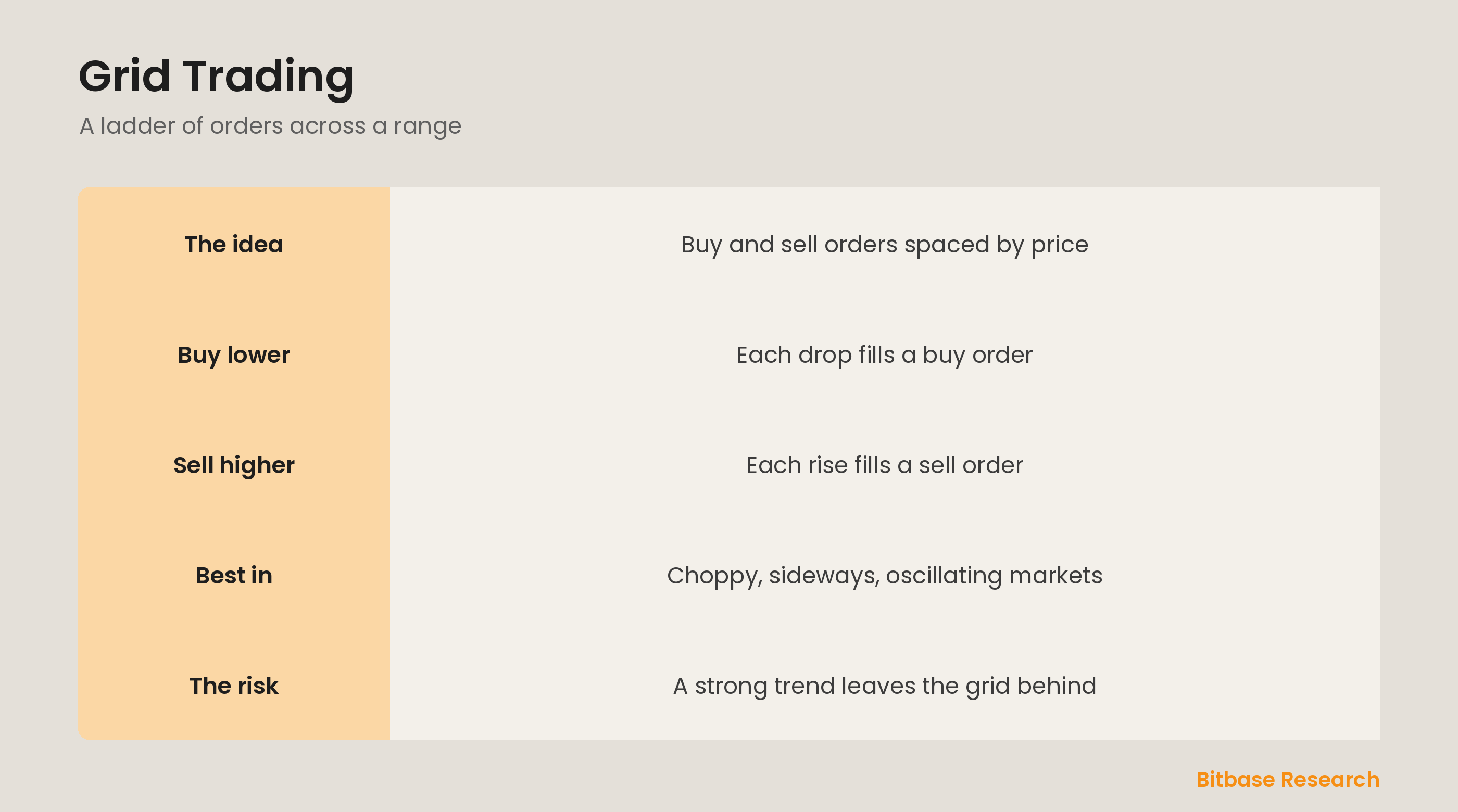
The strategy profits from volatility without needing to predict direction. When price dips, it fills a buy order at a lower level; when price rises again, it fills a sell order at a higher level, locking in the difference. Because a choppy market crosses the grid lines many times, the strategy accumulates many small gains from the same oscillation that frustrates directional traders. The more the market swings within the range, the more the grid earns.
Why it suits ranging markets
Grid trading is ideally suited to sideways, range-bound markets, exactly the conditions that hurt trend followers. In a market that keeps oscillating between two levels without going anywhere, a grid harvests profit from every swing. This makes it a natural complement to trend following: where a trend follower struggles in a range, a grid thrives, and where a grid struggles, a trend usually favors the trend follower instead.
The risk of a trend
The main risk of grid trading is a strong, sustained trend. If price breaks out of the grid's range and trends far in one direction, the grid can be left holding losing positions, buying repeatedly into a falling market or missing an escaping rally, with no oscillation to close the trades profitably. Because of this, grids need boundaries and risk controls, and they perform poorly exactly when a market stops ranging and starts trending decisively.
The bottom line
Grid trading places a ladder of buy and sell orders spaced by price across a range, buying automatically as price dips and selling as it rises, to profit from oscillation without predicting direction. It suits choppy, range-bound markets where price keeps swinging, harvesting many small gains. Its main risk is a strong trend that breaks out of the range, which can leave the grid holding losing positions, so it needs boundaries and risk controls. To keep learning the fundamentals, follow more from Bitbase Academy.
Disclaimer: This article is educational content from Bitbase Academy, provided for information only. It does not constitute investment, trading, tax, or financial advice. Crypto assets are volatile; assess your own risk. Written as of June 2026; refer to the latest official information.
References
[1] Investopedia, "Range-Bound Trading: Definition and How Strategy Works" investopedia.com
[2] Investopedia, "Limit Order: Definition, How It Works, and Types" investopedia.com
[3] Investopedia, "Volatility: Meaning in Finance and How It Works" investopedia.com