Not every pattern signals a reversal. Some mark a pause, a spot where a trend catches its breath before continuing. Flags, pennants, and triangles are the most common of these continuation patterns, and recognizing them helps you stay with a trend through its rest stops instead of exiting too soon. Here is what each of these shapes looks like, why they form, and how they typically resolve.
Flags
A flag forms after a sharp, strong move, called the flagpole. Price then consolidates in a small rectangular channel that tilts gently against the direction of the move, like a flag on a pole. The tight, slightly counter-trend drift represents a brief pause where some traders take profits before the trend resumes. Flags are short-lived and, being continuation patterns, usually break out in the same direction as the flagpole that preceded them, continuing the prior move.
Pennants
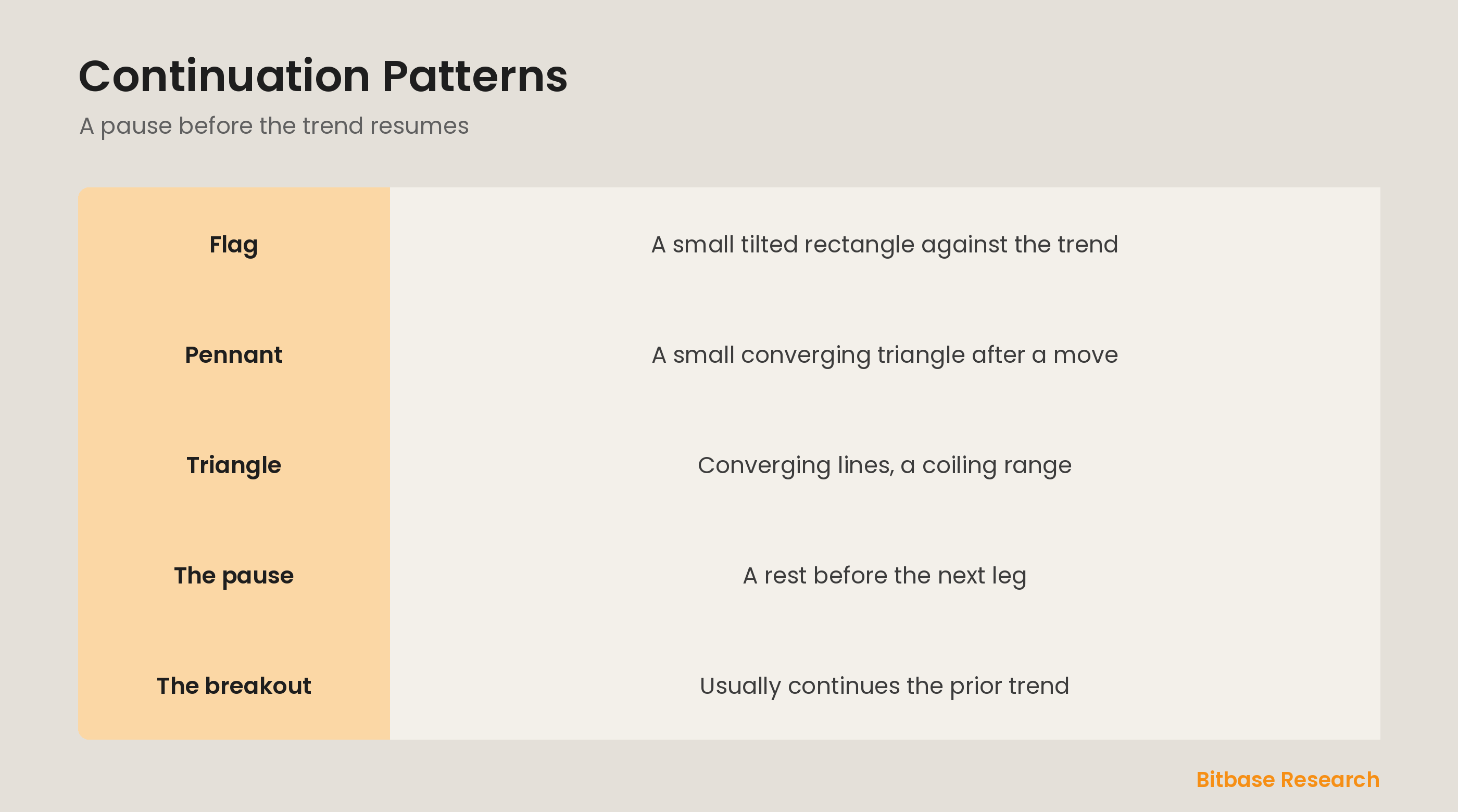
A pennant is close cousin to the flag, also forming after a sharp move, but instead of a tilted rectangle it takes the shape of a small symmetrical triangle, with the price range narrowing to a point. Like a flag, a pennant is a brief consolidation, a coiling pause after a strong leg. It too is a continuation pattern, typically breaking out in the direction of the preceding move as the trend resumes after its short rest.
Triangles
Triangles are consolidation shapes where price swings between converging trendlines, coiling into a tighter and tighter range. A symmetrical triangle has both lines converging and is often neutral. An ascending triangle has a flat top and rising lows, leaning bullish, while a descending triangle has a flat bottom and falling highs, leaning bearish. Triangles can be continuation or, less often, reversal patterns, so the direction of the breakout is what matters most.
How they resolve
What unites these patterns is that price eventually breaks out of the consolidation, and for continuation patterns the breakout usually goes in the direction of the prior trend. A common way to project the target is to measure the size of the move that led into the pattern and expect a similar move after the breakout. As always, the breakout should be confirmed, ideally on rising volume, since consolidations can occasionally break the other way.
The bottom line
Flags, pennants, and triangles are consolidation patterns that mark a pause in a trend rather than a reversal. A flag is a small tilted rectangle after a sharp move, a pennant is a small converging triangle, and triangles are coiling ranges between converging lines. As continuation patterns, they usually break out in the direction of the prior trend, and the breakout, confirmed on volume, is what signals the trend resuming. To keep learning the fundamentals, follow more from Bitbase Academy.
Disclaimer: This article is educational content from Bitbase Academy, provided for information only. It does not constitute investment, trading, tax, or financial advice. Crypto assets are volatile; assess your own risk. Written as of June 2026; refer to the latest official information.
References
[1] Investopedia, "Flag: Definition, Meaning, and Example in Trading" investopedia.com
[2] Investopedia, "Triangle: Definition, How It Works, Types, and Examples" investopedia.com
[3] Investopedia, "Continuation Pattern: Definition and Trading Strategies" investopedia.com