Two traders can send the same order a fraction of a second apart and get noticeably different prices. The difference is execution quality, shaped largely by latency, the small delays between deciding to trade and the trade actually happening. For most people these delays are invisible, but in a fast market they cost real money. Here is what execution quality means, where latency comes from, and why it matters more the faster things move.
What execution quality is
Execution quality measures how good your fill was relative to a fair reference, usually the market price at the moment you traded. A high-quality execution fills close to that price with little slippage; a poor one fills noticeably worse. Quality depends on the market's liquidity, your order type and size, and speed. It is why professionals obsess over execution: over many trades, small differences in fill quality add up to a large difference in results.
What latency is
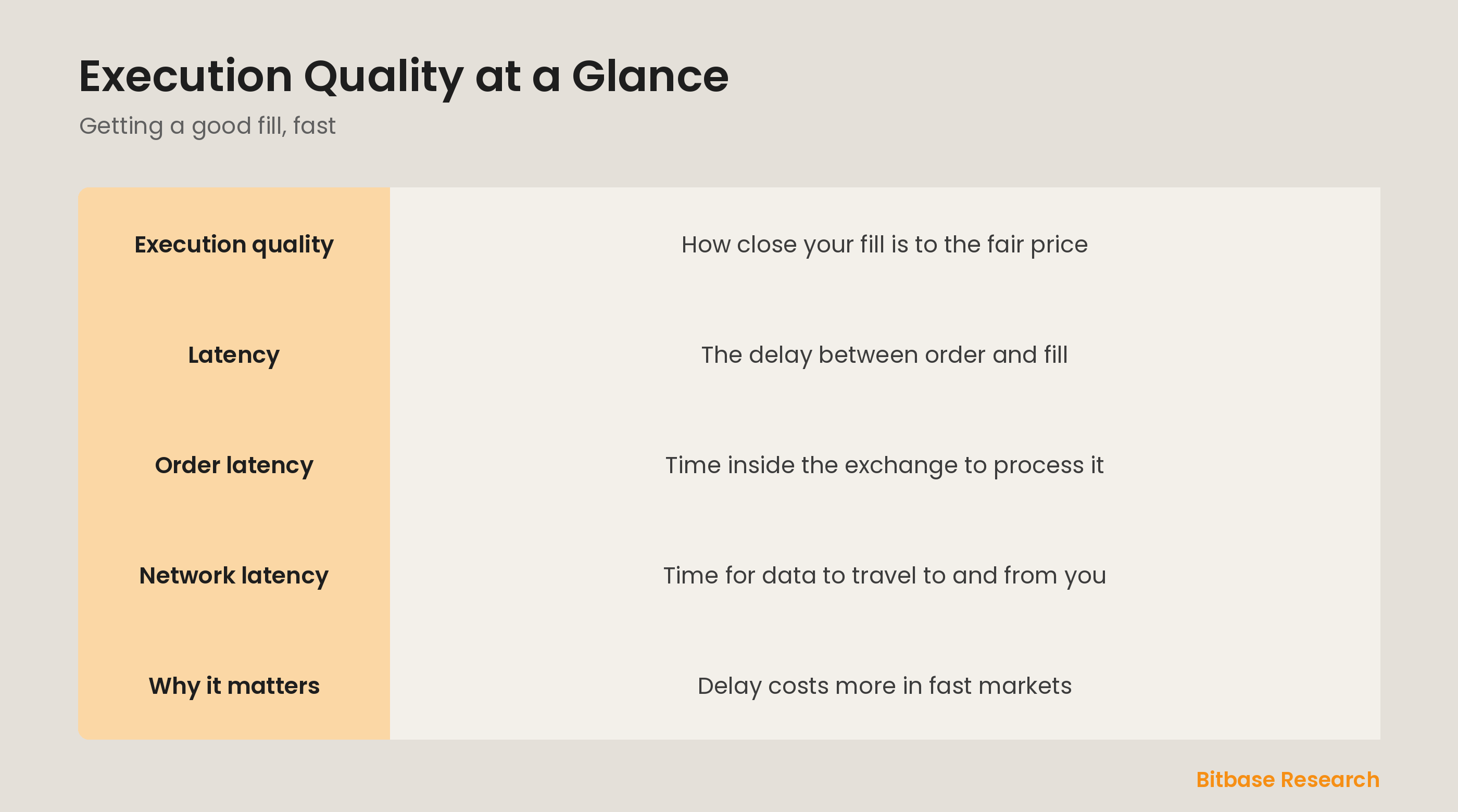
Latency is the delay between when you commit to an order and when it actually executes. In that gap, however brief, the market can move, and if it moves against you, your fill is worse than expected. Latency is not one thing but a chain of small delays along the path your order travels. Even a few hundred milliseconds can matter when the price is jumping, which is why speed is a genuine edge in active trading.
Order latency vs network latency
Latency has two main sources. Network latency is the time it takes data to travel between you and the exchange, across the internet, which depends on your connection and physical distance to the servers. Order latency, or exchange latency, is the time the exchange itself takes to receive, process, and match your order once it arrives. Both add to the total delay, and both can spike when systems are overloaded during volatile, high-volume moments.
Why latency matters more at speed
In a calm, slow market, a little delay barely changes your price, so latency is nearly irrelevant. In a fast, volatile one, the price can move meaningfully in the time your order is in transit and being processed, turning a small delay into real slippage. This is why latency matters most exactly when trading is hardest, and why active traders value a reliable connection, a responsive exchange, and, above all, not chasing every fast move.
The bottom line
Execution quality is how close your fill lands to the fair price, and latency, the delay between your order and its execution, is a big driver of it. That delay comes from network latency, data traveling to and from the exchange, and order latency, the exchange processing your order. In calm markets it barely matters; in fast ones it becomes real slippage. Value speed and reliability, but also avoid trading into chaos where latency hurts most. To keep learning the fundamentals, follow more from Bitbase Academy.
Disclaimer: This article is educational content from Bitbase Academy, provided for information only. It does not constitute investment, trading, tax, or financial advice. Crypto assets are volatile; assess your own risk. Written as of June 2026; refer to the latest official information.
References
[1] Investopedia, "Latency: What It Is, How It Works in Trading" investopedia.com
[2] Investopedia, "Market Order: Definition, Example, Vs. Limit Order" investopedia.com
[3] Investopedia, "Best Execution: Meaning, Investment Types, Example" investopedia.com