
Most candles clearly favor buyers or sellers, but the doji is the candle of a tie. When a period opens and closes at almost the same price, neither side won, and the result is a distinctive cross-shaped candle with barely any body. The doji is the market's way of showing hesitation, and after a strong trend, that hesitation can be meaningful. Here is what a doji is, its main variations, and how to read it.
What makes a doji
A doji forms when a candle opens and closes at nearly the same price, leaving almost no body, just a thin horizontal line with wicks above and below. During the period, price may have moved up and down, but by the close it returned to where it started. That balance means buyers and sellers fought to a draw. Because it shows neither side gained control, the doji represents indecision, a pause in the ongoing battle over direction.
What indecision signals
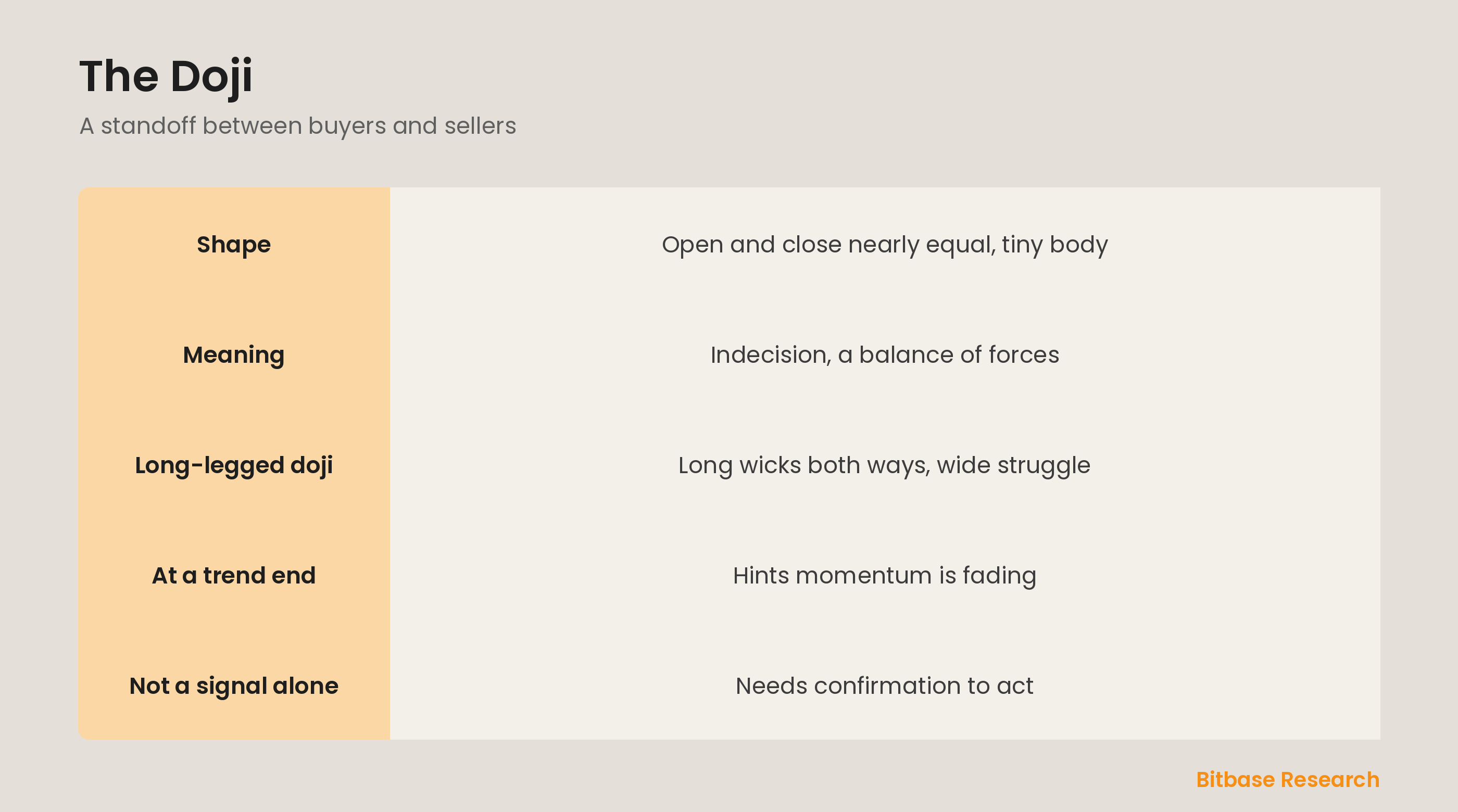
Indecision matters most in relation to what came before. In the middle of a quiet, sideways market, a doji is unremarkable; the market was already undecided. But after a strong run in one direction, a doji stands out, because it shows the momentum that had been driving price has suddenly stalled into a stalemate. That loss of momentum is why a doji after a trend is watched as a possible early warning that the trend could be tiring.
Common doji types
Dojis come in a few recognizable shapes. A standard doji has small, roughly equal wicks. A long-legged doji has long wicks both up and down, showing a wide struggle that still ended in balance, a stronger sign of indecision. A dragonfly doji has a long lower wick and no upper one, hinting at rejection of lows, while a gravestone doji has a long upper wick and no lower one, hinting at rejection of highs. The wicks color the message.
How to use a doji
A doji is a heads-up, not a trigger. On its own it only says the market paused; it does not tell you which way it will break next. Traders treat a doji at the end of a trend as a reason to pay attention and then wait for the following candles to confirm a direction before acting. Used this way, it is a useful early signal of fading momentum rather than a standalone reason to buy or sell.
The bottom line
A doji is a candle where the open and close are nearly equal, leaving a tiny body that signals indecision, a draw between buyers and sellers. Variations like the long-legged, dragonfly, and gravestone doji shade that message with their wicks. A doji matters most after a strong trend, where it hints the momentum is fading. But it is a warning to watch, not a signal to trade alone, so wait for confirmation before you act on it. To keep learning the fundamentals, follow more from Bitbase Academy.
Disclaimer: This article is educational content from Bitbase Academy, provided for information only. It does not constitute investment, trading, tax, or financial advice. Crypto assets are volatile; assess your own risk. Written as of June 2026; refer to the latest official information.
References
[1] Investopedia, "Doji: What It Is, What It Signifies, With Examples" investopedia.com
[2] Investopedia, "Candlestick: What It Is, What It Tells Investors" investopedia.com
[3] Investopedia, "Price Action: What It Is and How Stock Traders Use It" investopedia.com