Not every strategy is about trading the swings. For many crypto investors, the question is simpler: when you have money to put in, do you invest it all at once or spread it out over time? These two approaches, lump-sum investing and dollar-cost averaging, answer that differently, and each has real advantages. Here is how dollar-cost averaging works, how it compares to lump-sum, and the trade-off between them.
What dollar-cost averaging is
Dollar-cost averaging, or DCA, means investing a fixed amount of money at regular intervals, regardless of the price, rather than all at once. For example, buying the same dollar amount of an asset every week or month. Because the amount is fixed, you automatically buy more units when the price is low and fewer when it is high, which averages out your entry price over time and removes the need to time the market.
The benefit of DCA
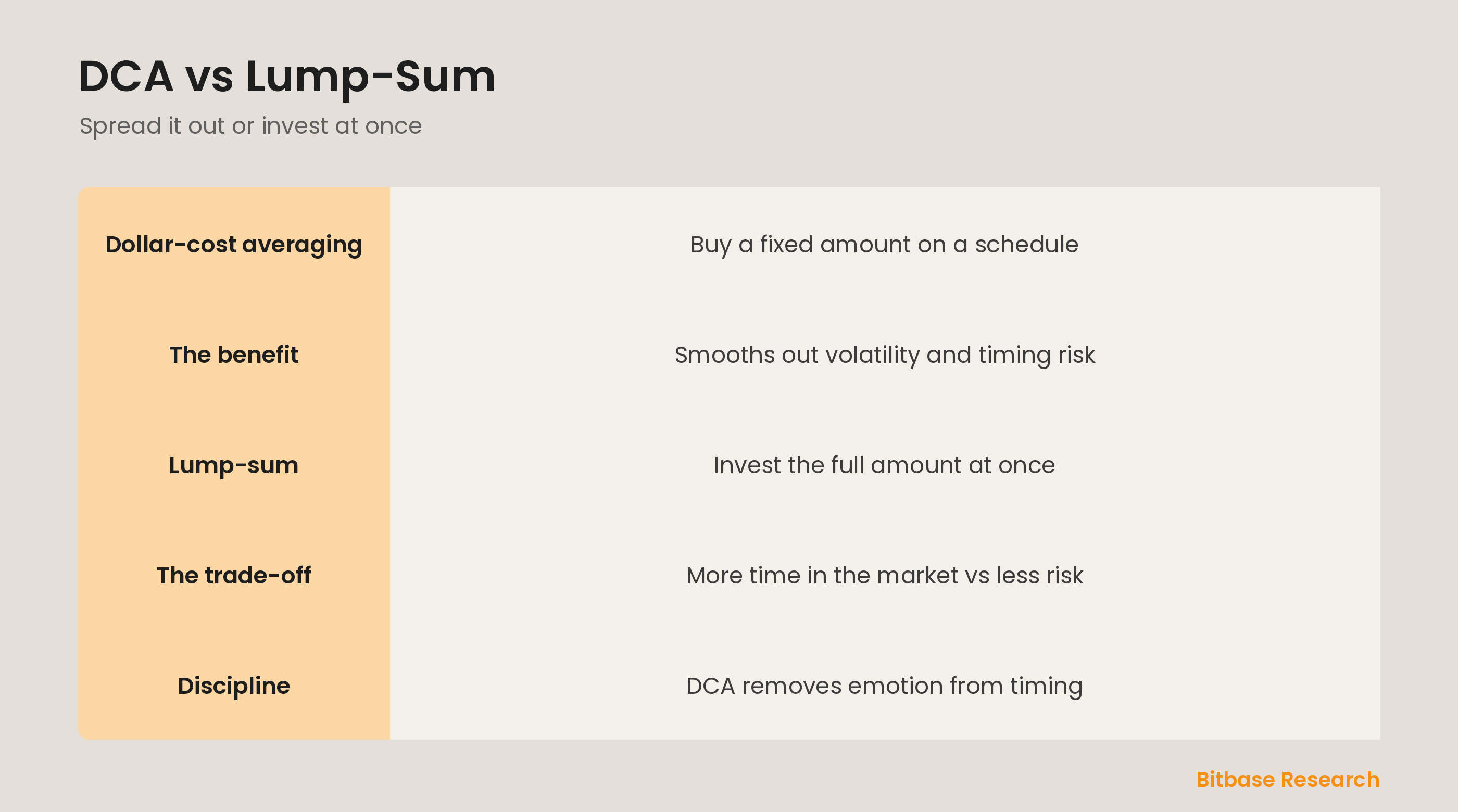
The main appeal of DCA is that it smooths out volatility and reduces timing risk. In a market as volatile as crypto, investing everything on a single day carries the risk of buying right before a drop. By spreading purchases across many dates, DCA blends good and bad entry points into a moderate average, so a badly timed lump is impossible. It also builds discipline, turning investing into a routine and removing the emotional stress of deciding when to buy.
Lump-sum investing
Lump-sum investing is the alternative: putting the full amount in at once, rather than spreading it. Its advantage is time in the market. Since markets tend to rise over the long run, money invested sooner has more time to grow, and on average, investing a lump sum earlier beats spreading it out. The catch is risk: a lump sum invested right before a downturn suffers the full drop, which can be hard to stomach emotionally even if the long-run math favors it.
The trade-off
The choice between them is a trade-off between expected return and risk. Lump-sum tends to produce higher returns on average because more money is working sooner, but it carries more risk of a poorly timed entry. DCA gives up some of that expected return in exchange for smoother, lower-risk entries and less emotional strain. For volatile crypto and for investors who value steadiness and discipline, DCA is popular precisely because it removes the pressure of timing.
The bottom line
Dollar-cost averaging invests a fixed amount at regular intervals regardless of price, smoothing out volatility and removing the need to time the market, while lump-sum investing puts the full amount in at once for maximum time in the market. Lump-sum tends to earn more on average but risks a badly timed entry, while DCA trades some expected return for lower risk and discipline. For volatile crypto, DCA is popular for its steadiness. This is general information, not financial advice. To keep learning the fundamentals, follow more from Bitbase Academy.
Disclaimer: This article is educational content from Bitbase Academy, provided for information only. It does not constitute investment, trading, tax, or financial advice. Crypto assets are volatile; assess your own risk. Written as of June 2026; refer to the latest official information.
References
[1] Investopedia, "Dollar-Cost Averaging (DCA): How It Works and Example" investopedia.com
[2] Investopedia, "Volatility: Meaning in Finance and How It Works" investopedia.com
[3] Investopedia, "Technical Analysis: What It Is and How to Use It" investopedia.com