When you tap buy or sell on a spot exchange, your order does not simply happen. It travels through a short lifecycle, from being placed, to waiting, to filling, to settling, and understanding that path answers a lot of beginner questions at once. Why does my order just sit there? Why did only part of it fill? Why was it rejected as too small? Here is the spot order lifecycle, step by step.
Placing and settlement
The lifecycle starts when you submit an order and the exchange accepts it. On spot, settlement is effectively immediate: the moment a trade executes, the assets change hands and your balances update, unlike traditional markets where settlement can take days. That is what spot means. A market order usually completes this journey in an instant, because it trades against whatever prices are already available.
Why an order stays open
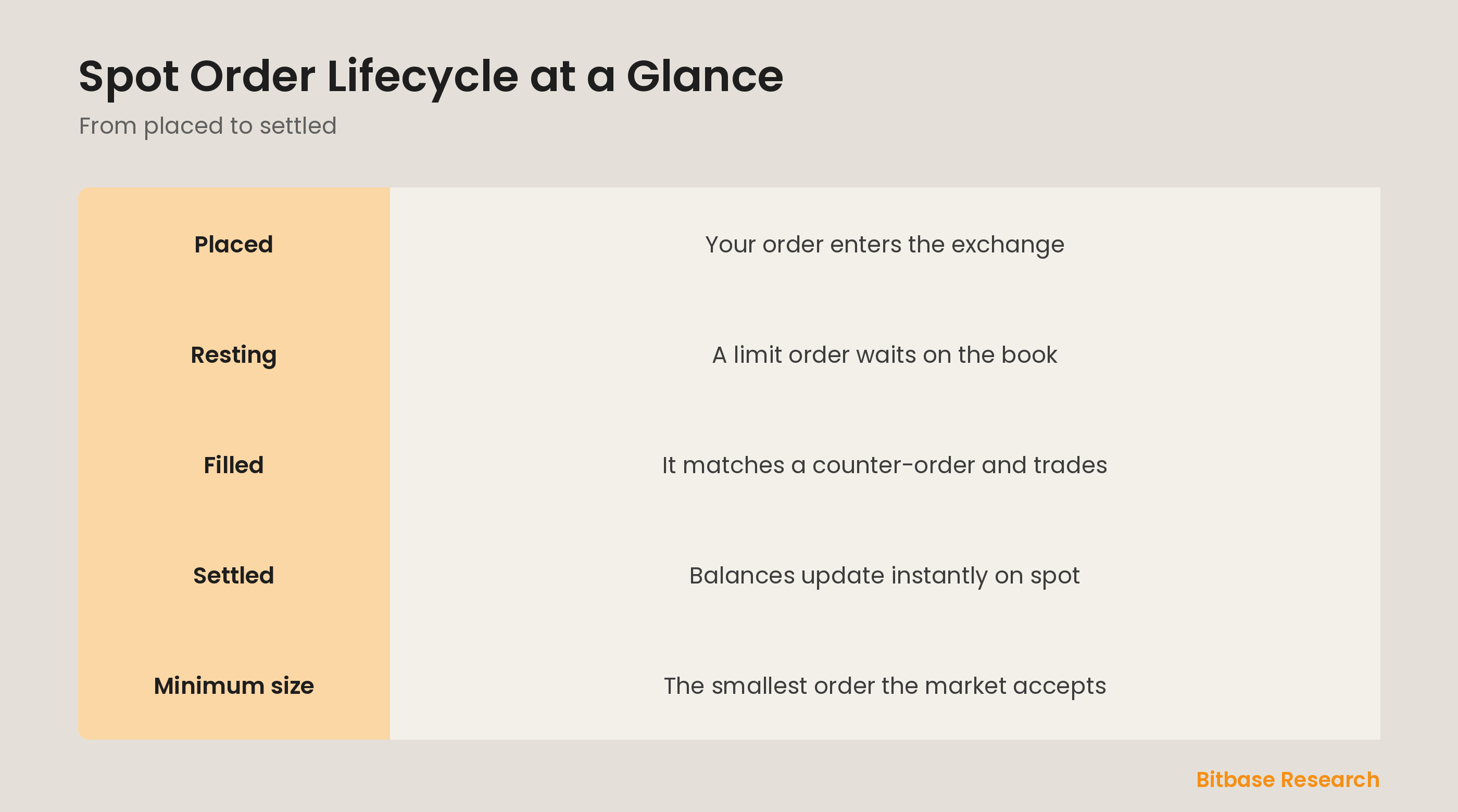
A limit order is different. It only trades at your chosen price or better, so if the market has not reached that price, the order does not execute. Instead it rests on the order book and waits, staying open until the price comes to it, you cancel it, or it expires. An order sitting untouched is not broken; it is simply waiting for a counterparty willing to trade at your terms.
How partial fills happen
An order does not always fill all at once. If your order is larger than the quantity available at your price, it can fill in pieces, matching whatever is there now and leaving the rest open to fill later. That is a partial fill. You might buy half your intended amount immediately and the other half minutes later, or not at all if the price moves away. Partial fills are normal, especially for large orders or thin markets.
Minimum order size
Every market sets a minimum order size, the smallest quantity or value it will accept. Try to trade below it and the order is rejected. Minimums exist to keep the order book clean and avoid dust-sized trades that clog the system. If an order fails for being too small, increase the amount to meet the market minimum, which the exchange displays for each pair.
The bottom line
A spot order moves through a clear lifecycle: you place it, a limit order may rest on the book and wait, it fills fully or in parts as counter-orders appear, and on spot it settles instantly so balances update at once. Each stage explains a common surprise, from orders that sit open to partial fills to too-small rejections. Knowing the path turns those surprises into things you expect and control. To keep learning the fundamentals, follow more from Bitbase Academy.
Disclaimer: This article is educational content from Bitbase Academy, provided for information only. It does not constitute investment, trading, tax, or financial advice. Crypto assets are volatile; assess your own risk. Written as of June 2026; refer to the latest official information.
References
[1] Investopedia, "Spot Trade: What It Is, How It Works, and Types" investopedia.com
[2] Investopedia, "Limit Order: Definition, How It Works, and Types" investopedia.com
[3] Investopedia, "Fill: What It Means, How It Works, Types, and Example" investopedia.com