You place an order at one price and it fills at another. That gap is slippage, one of the most common and misunderstood costs in crypto trading. It is usually small, occasionally brutal, and always worth understanding, because you can control much of it. Here is what slippage is, why it can go your way or against you, how a slippage tolerance protects you, and the conditions that cause it.
What slippage is
Slippage is the difference between the price you expected when you placed an order and the price it actually filled at. It happens because the market moves in the instant your order travels and executes, or because your order is larger than the liquidity at the best price. It is not a fee and not a bug; it is the natural result of trading against a live, moving market. Every market order carries some slippage risk, though usually a tiny one.
Negative versus positive slippage
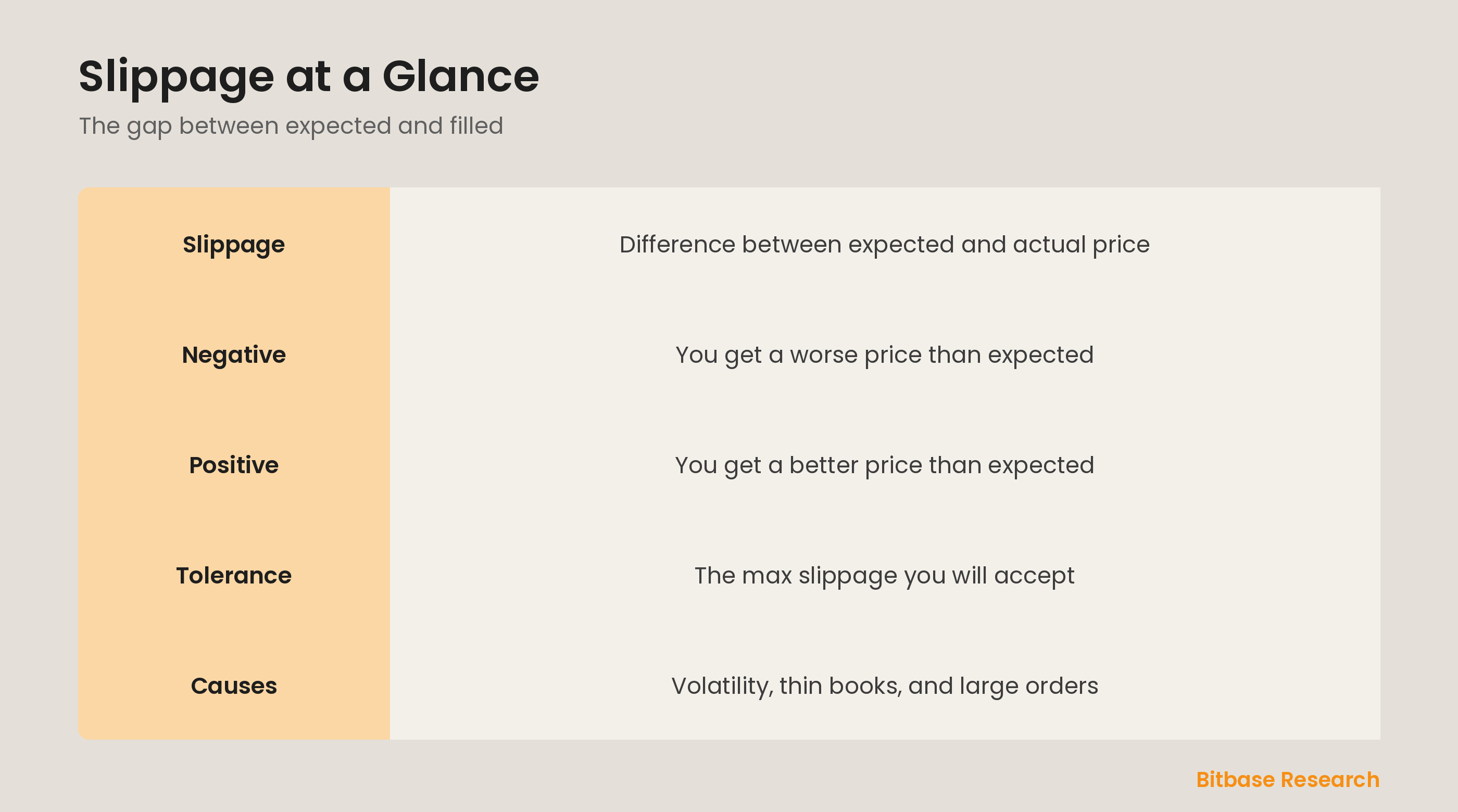
Slippage can cut both ways. Negative slippage means you got a worse price than expected: your buy filled higher, or your sell filled lower. This is the case people fear. But positive slippage also happens, when the price moves in your favor between order and fill and you get a better price than you asked for. On average, slippage is a cost, but it is not always against you; it is simply the market being different by the time you fill.
Slippage tolerance
A slippage tolerance is a limit you set on how much slippage you will accept. You tell the exchange to fill your order only if the price is within, say, half a percent of the expected price; if the market has moved more than that, the order is rejected rather than filled at a bad price. It is a safety valve, protecting you from a wild fill in fast conditions. Set it too tight and orders fail to fill; too loose and you risk a nasty price.
What causes slippage
Three conditions drive slippage. Volatility is the biggest: when the price is moving fast, it is likely to have shifted by the time you fill. Thin liquidity is next: on a shallow book, there is little at the best price, so orders climb through worse ones. And order size matters: a large order relative to the book eats through multiple price levels, guaranteeing slippage. Trading calmer markets, deeper pairs, and smaller sizes all reduce it.
The bottom line
Slippage is the gap between the price you expected and the price you got, and it can be negative, worse for you, or positive, better. A slippage tolerance caps how much you will accept, rejecting fills that stray too far. It is caused mainly by volatility, thin order books, and large orders relative to available liquidity. You cannot eliminate slippage, but trading liquid pairs in calmer conditions with sensible sizes and a set tolerance keeps it small. To keep learning the fundamentals, follow more from Bitbase Academy.
Disclaimer: This article is educational content from Bitbase Academy, provided for information only. It does not constitute investment, trading, tax, or financial advice. Crypto assets are volatile; assess your own risk. Written as of June 2026; refer to the latest official information.
References
[1] Investopedia, "Slippage: What It Means in Finance, With Examples" investopedia.com
[2] Investopedia, "Market Order: Definition, Example, Vs. Limit Order" investopedia.com
[3] Investopedia, "Bid-Ask Spread: Definition, Meaning, and How It Works" investopedia.com