Sometimes a single price on the order book holds a huge pile of orders, so large it looks like a wall. Buy walls and sell walls catch every trader's eye because they seem to mark where the price will stop. Sometimes they do, and sometimes they vanish the moment the price arrives. Understanding walls, and the book depth around them, tells you a lot about where a market can and cannot move. Here is how they work.
What a buy or sell wall is
A buy wall is an unusually large cluster of buy orders stacked at one price below the current market, and a sell wall is the same on the sell side above the market. On a depth chart or heatmap they show up as a tall step or a bright band. A wall represents a lot of liquidity concentrated at one level: for the price to pass through it, all those orders must be filled first, which takes real volume.
How a wall acts as support or resistance
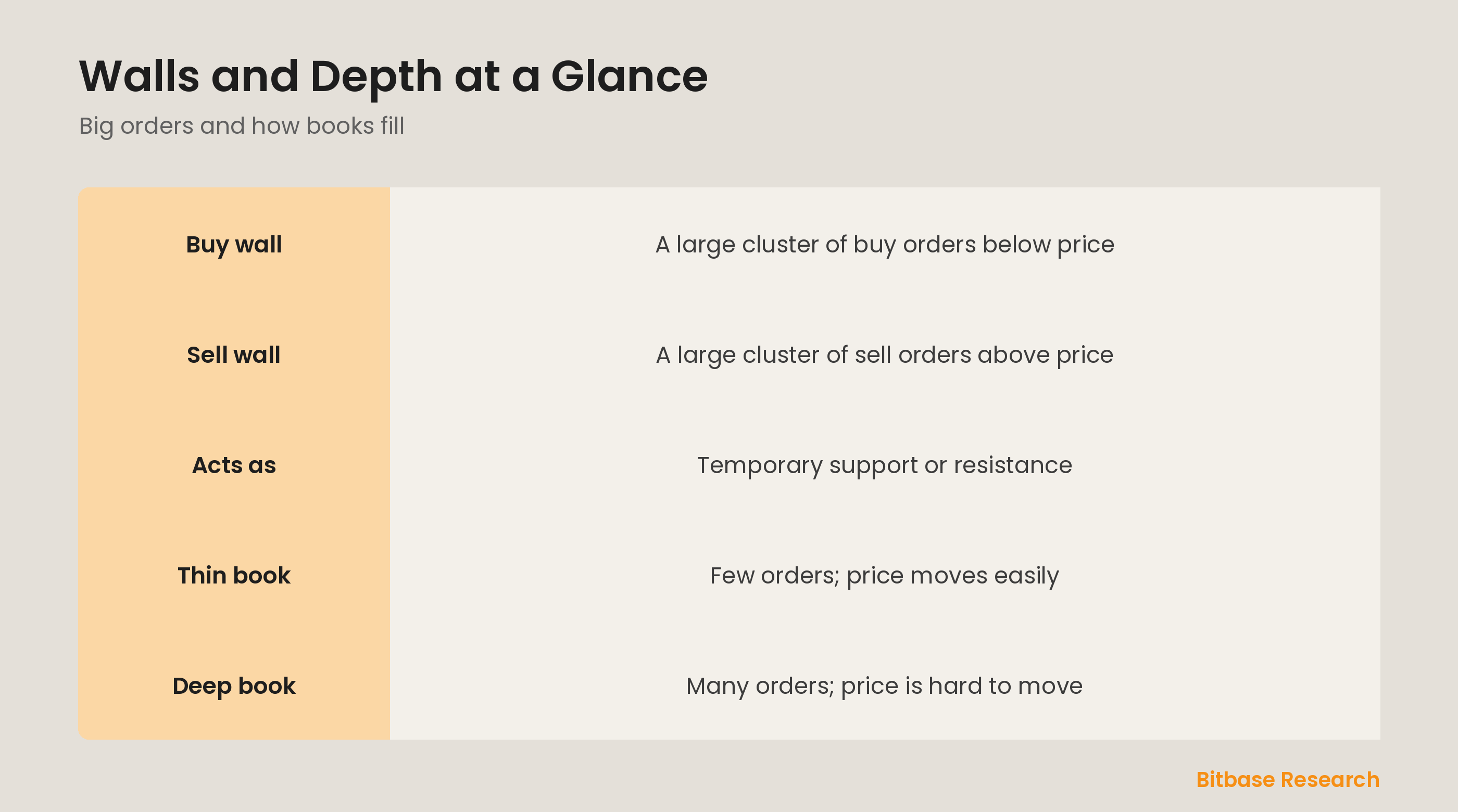
Because a wall soaks up orders, it often behaves like temporary support or resistance. A big buy wall below can slow or stop a falling price, since sellers must exhaust it to push lower; a sell wall above can cap a rally. Traders watch walls as potential turning points. But a wall is only as real as the intent behind it, and that is where caution is needed.
Why walls can be misleading
A wall is not a guarantee. Some are genuine, placed by large holders who truly want to buy or sell at that price. Others are fake, placed to create the illusion of support or resistance and then pulled before they fill, a manipulative tactic. A wall that keeps reappearing but never actually trades is suspicious. Treat walls as information about intent, not certainty, and never assume a price cannot break through one.
Thin versus deep books
Walls are extreme points, but overall book depth matters just as much. A deep book has plenty of orders at every level, so the price is stable and large trades fill with little slippage. A thin book has sparse orders, so even a modest trade, or the removal of one wall, can send the price flying. Knowing whether you are in a deep or thin market tells you how much a given order will move things.
The bottom line
A buy wall or sell wall is a large cluster of orders at one price that can act as temporary support or resistance, because the market must absorb it to move past. But walls can be genuine or fake, so treat them as clues, not guarantees. Around them, overall depth decides everything: a deep book resists movement, while a thin book lets price run on little volume. Read walls and depth together. To keep learning the fundamentals, follow more from Bitbase Academy.
Disclaimer: This article is educational content from Bitbase Academy, provided for information only. It does not constitute investment, trading, tax, or financial advice. Crypto assets are volatile; assess your own risk. Written as of June 2026; refer to the latest official information.
References
[1] Investopedia, "Order Book: Definition, How It Works, and Key Parts" investopedia.com
[2] Investopedia, "Liquidity: Definition, Example, and How It Works" investopedia.com
[3] Investopedia, "Depth of Market (DOM): Definition and How It Is Used" investopedia.com