
Breakout trading tries to catch a new move right at its start, entering as price breaks out of a range or through a key level. Done well, it can put you into a strong trend from the beginning. Done carelessly, it exposes you to the false breakouts that make this one of the trickier strategies. The whole game is separating real breaks from fakes. Here is how breakout trading works and how to manage its main risk.
The core idea
Breakout trading aims to enter a trade at the moment price decisively leaves a defined area, such as breaking above the resistance of a range or below its support. The logic is that once price escapes a level it had been stuck at, a new directional move often follows, and getting in at the break means catching that move early. Breakout traders look for clear, well-tested levels, since a break of an important level tends to matter more.
Confirming the breakout
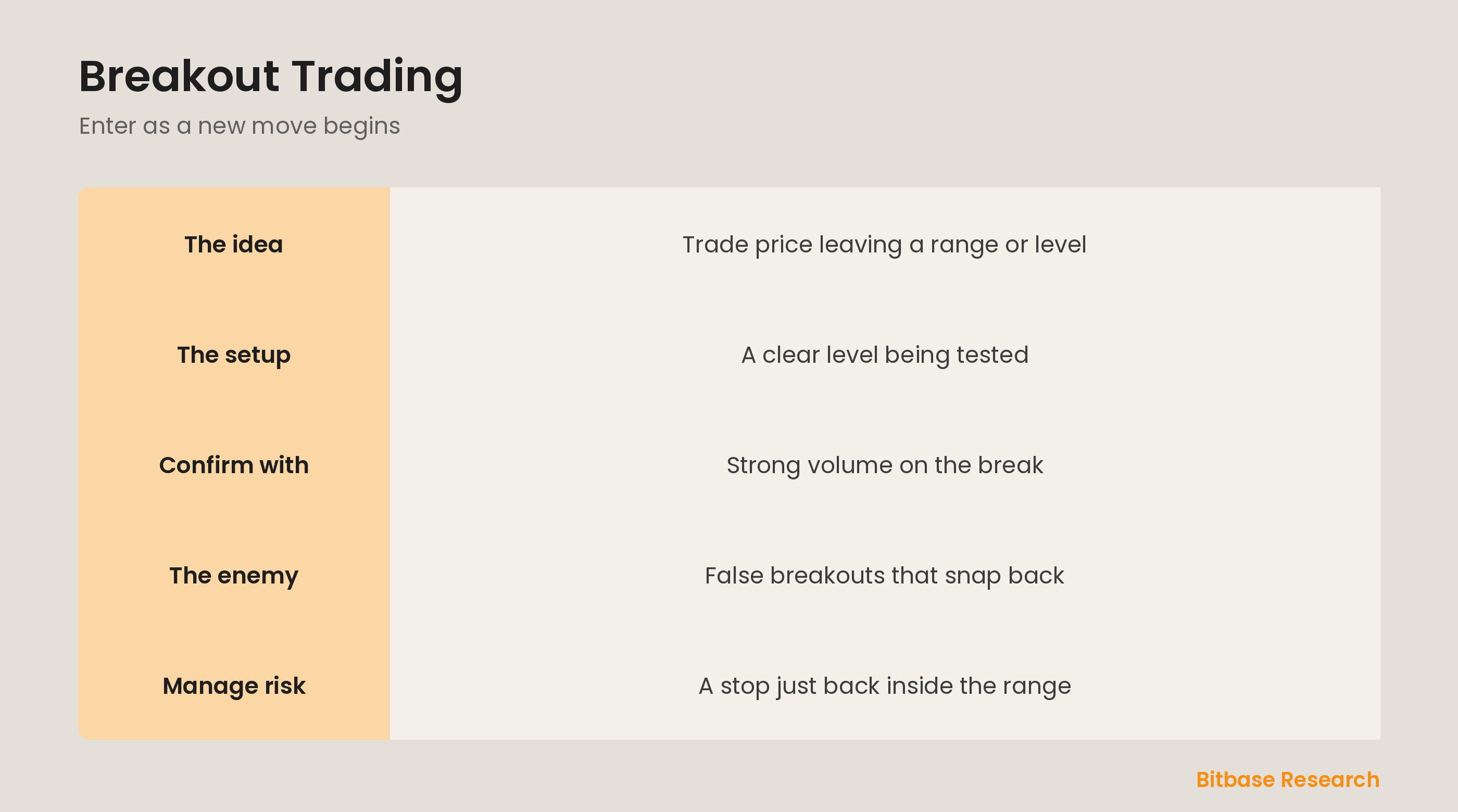
The biggest challenge in breakout trading is telling a real breakout from a false one. The most useful confirmation is volume: a genuine breakout usually comes on a surge of volume, showing real participation behind the move, while a break on weak volume is suspect. Some traders also wait for the candle to close beyond the level rather than just poke through it, or for a successful retest of the broken level, to filter out fakes before committing.
Managing false breakouts
False breakouts are the breakout trader's main enemy: price pierces the level, triggers entries, then snaps back inside, trapping those who jumped in. The defense is disciplined risk management. A breakout trade needs a tight, well-placed stop-loss, typically just back inside the range, so that if the break fails, the loss is small and quick. Accepting that some breakouts will fail and keeping those losses small is what keeps the strategy viable over many trades.
When breakout trading shines
Breakout trading works best at the transition from a range to a trend, exactly the moment a balanced market tips into a directional one. When a long consolidation finally resolves with a strong, high-volume break, a breakout trader can ride the fresh trend from early on. The strategy pairs naturally with volatility: quiet, tight ranges often precede big breaks, so watching for a coiling market and a decisive break is the classic breakout setup.
The bottom line
Breakout trading enters as price decisively leaves a range or key level, aiming to catch a new move from the start. Its biggest risk is the false breakout, so traders confirm with strong volume, a close beyond the level, or a retest, and always use a tight stop just inside the range to keep failed breaks cheap. It shines at the transition from a quiet range to a strong trend, especially when a break comes on heavy volume. To keep learning the fundamentals, follow more from Bitbase Academy.
Disclaimer: This article is educational content from Bitbase Academy, provided for information only. It does not constitute investment, trading, tax, or financial advice. Crypto assets are volatile; assess your own risk. Written as of June 2026; refer to the latest official information.
References
[1] Investopedia, "Breakout: What It Means, Examples, and How To Trade" investopedia.com
[2] Investopedia, "Volatility: Meaning in Finance and How It Works" investopedia.com
[3] Investopedia, "Technical Analysis: What It Is and How to Use It" investopedia.com