Conditional orders are ones that do nothing until the market reaches a price you name. They let you automate an entire plan, wrapping a trade in a target and a stop, or waiting patiently for a level before acting. Bracket orders, close-on-trigger, market-if-touched, and limit-if-touched are the main types. Understanding them lets you set up a trade to manage itself. Here is what each does.
What a bracket order is
A bracket order wraps a trade in three parts at once: the entry, a take-profit above it, and a stop-loss below it. The moment your entry fills, the target and the stop go live automatically, and whichever hits first closes the trade while the other is cancelled. It is essentially an entry plus an OCO exit, packaged so you plan the whole trade in one step and never leave a position without protection.
Close-on-trigger orders
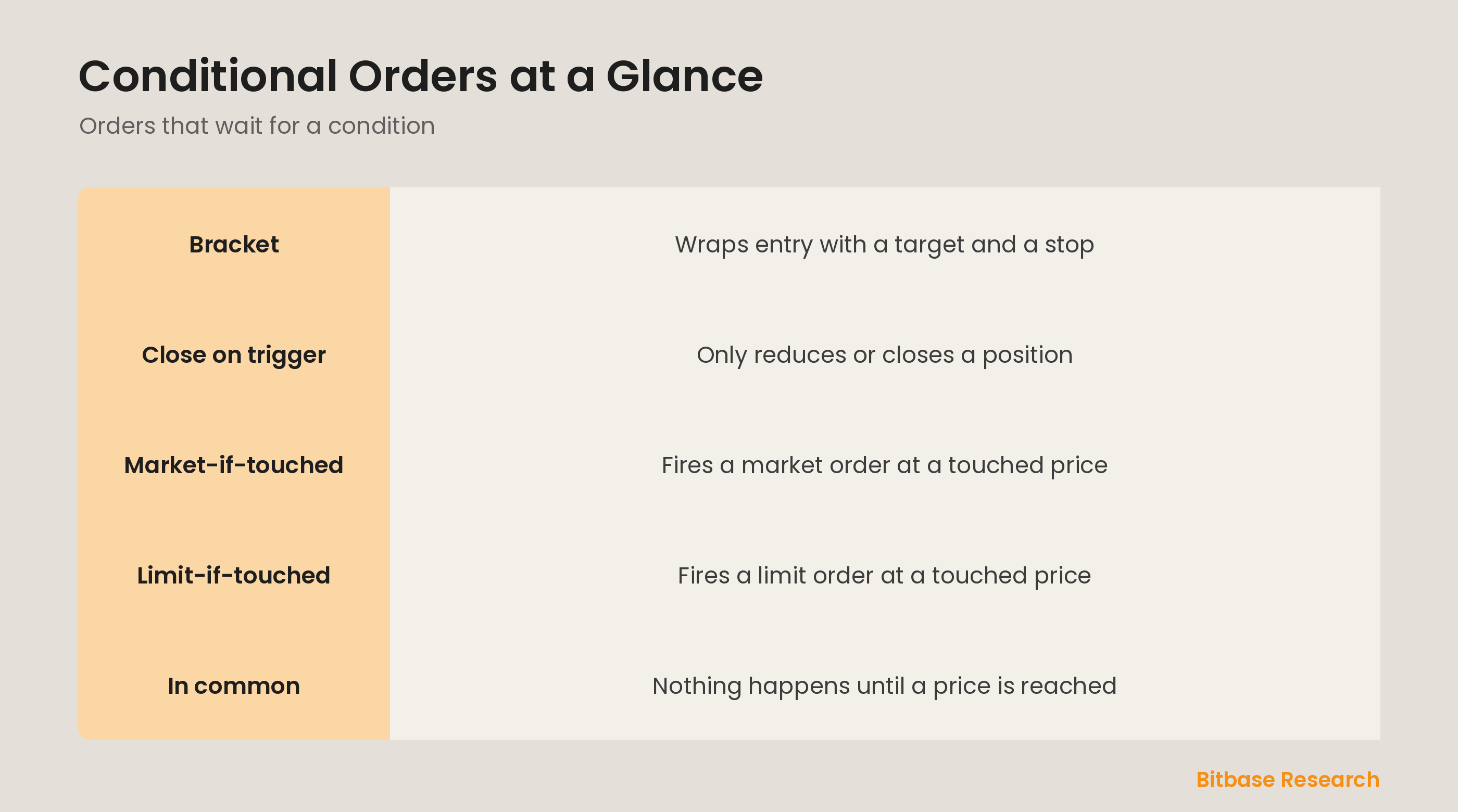
A close-on-trigger, or reduce-only, order is one that can only shrink or close an existing position, never open or add to one. It exists to prevent a costly mistake: an exit order accidentally flipping you into a new position in the opposite direction. When you set a stop or take-profit as reduce-only, you guarantee it can do nothing except reduce your risk, which is exactly what an exit should do.
Market-if-touched and limit-if-touched
A market-if-touched, or MIT, order waits until the price touches a level you set, then fires a market order to execute immediately. A limit-if-touched, or LIT, does the same but fires a limit order instead, so it only fills at your price or better. Both are conditional entries or exits: they sit dormant until the trigger price is touched, then activate. MIT prioritizes a guaranteed fill; LIT prioritizes price control.
How they fit together
These order types share one idea: nothing happens until a condition is met, which lets you pre-plan and step away. A bracket automates a full trade with its exits. Reduce-only keeps exits safe. MIT and LIT let you queue an action for a price you are waiting on. Combined, they turn trading from a series of manual clicks into a set of rules the exchange carries out for you, exactly as you specified.
The bottom line
Conditional orders wait for a price before acting. A bracket order wraps an entry with an automatic take-profit and stop-loss; a reduce-only order can only close or shrink a position; a market-if-touched fires a market order at a touched price, and a limit-if-touched fires a limit order. Together they let you build a trade that manages its own entry, protection, and exit, so your plan runs even when you are not watching. To keep learning the fundamentals, follow more from Bitbase Academy.
Disclaimer: This article is educational content from Bitbase Academy, provided for information only. It does not constitute investment, trading, tax, or financial advice. Crypto assets are volatile; assess your own risk. Written as of June 2026; refer to the latest official information.
References
[1] Investopedia, "Limit Order: Definition, How It Works, and Types" investopedia.com
[2] Investopedia, "Take-Profit Order (TP): Definition, Use in Trading, and Example" investopedia.com
[3] Investopedia, "Stop-Loss Order: Definition, How It Works, and Examples" investopedia.com