One of the loudest narratives in crypto right now is the "machine economy": software agents that hold their own wallets, make their own decisions, and transact on-chain without a human clicking anything. AI agents have grown from a curiosity into a multibillion-dollar sector. Here is what they actually are, why crypto suits them, and where the hype outruns reality.
What an AI agent is
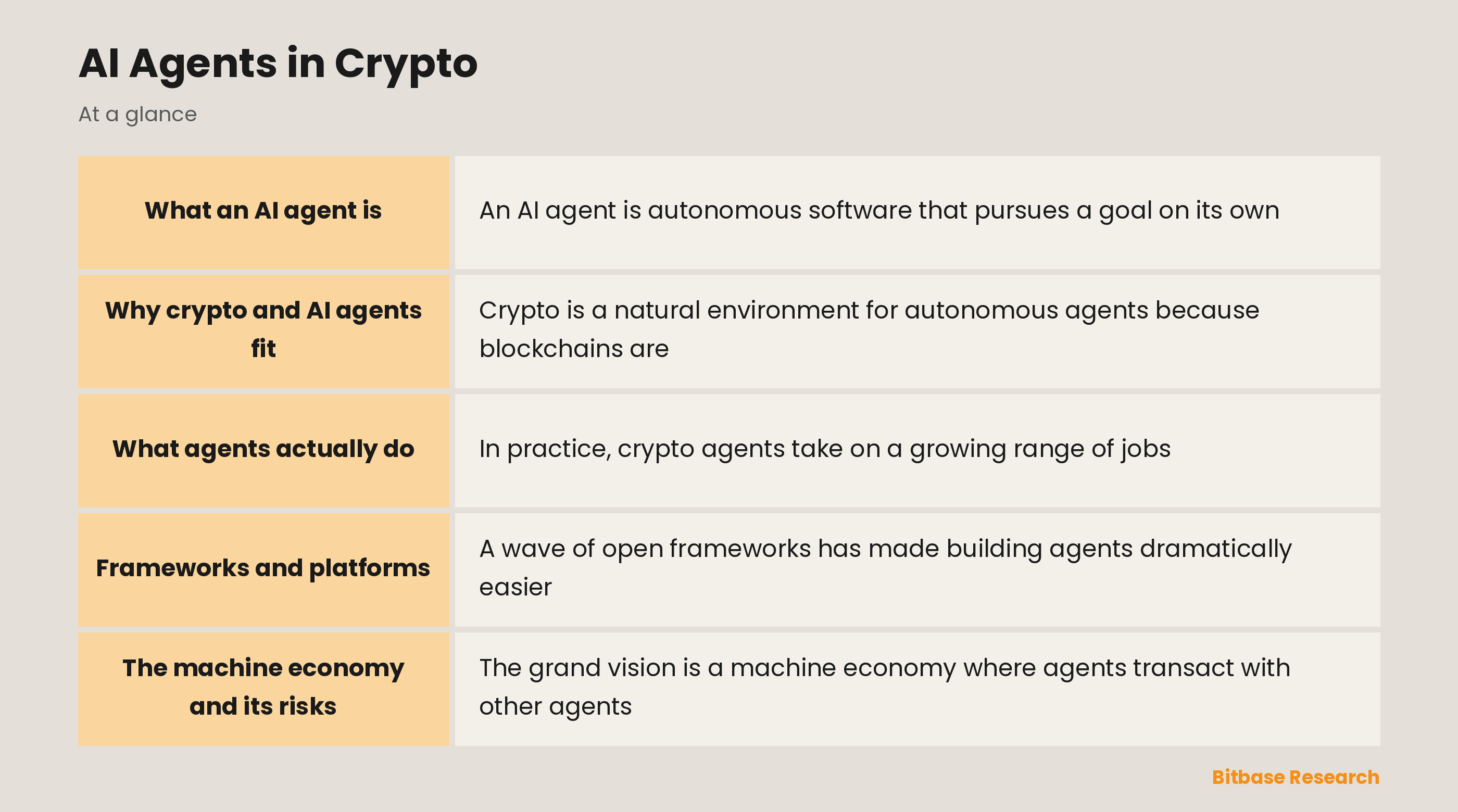
An AI agent is autonomous software that pursues a goal on its own: it gathers information, reasons about what to do, and then takes real actions to advance that goal. Unlike a simple chatbot that only answers, an agent acts — it can execute tasks, respond to changing conditions, and operate continuously without supervision. In crypto specifically, an agent is typically given a wallet and the ability to transact, which turns its decisions into on-chain consequences with real money behind them.
Why crypto and AI agents fit
Crypto is a natural environment for autonomous agents because blockchains are built for programmatic, permissionless action. A wallet gives an agent a native way to hold and move value without a bank account or human approval, smart contracts give it services it can call directly, and markets run every hour of every day. An agent can therefore sense on-chain data, hold funds, and act on them entirely within the same open system, which is far harder to do in the permissioned world of traditional finance.
What agents actually do
In practice, crypto agents take on a growing range of jobs. Some monitor markets and execute trades or manage positions in decentralised finance. Others run social accounts, publish content, and build audiences, while some coordinate tasks or even launch tokens of their own. The common thread is autonomy over money and information: an agent combines a language model's reasoning with a wallet's ability to act, so it can move from deciding something to doing it without a person in the loop.
Frameworks and platforms
A wave of open frameworks has made building agents dramatically easier, letting developers give an agent memory, personality, and the ability to act across platforms. Alongside these, launchpad-style platforms let people create and deploy agents quickly, often paired with a token tied to the agent or its ecosystem. This tooling is why the sector exploded so fast, but it also means many agents are thin wrappers around a model and a token, with far more marketing than genuine capability.
The machine economy and its risks
The grand vision is a machine economy where agents transact with other agents, hire each other, and settle payments autonomously, with crypto as the money layer. It is a genuinely novel idea, but the risks are as large as the promise. Many agent tokens are pure speculation, an autonomous wallet is a serious security target, and an agent acting on flawed reasoning can lose funds fast. Giving software real money and real autonomy raises hard questions about safety, accountability, and control.
The bottom line
AI agents in crypto are autonomous programs that hold wallets and act on-chain, combining AI reasoning with the permissionless, always-on nature of blockchains. They already trade, post, and coordinate, and open frameworks have made them easy to build, fuelling a fast-growing and heavily hyped sector. The concept is real and potentially transformative, but most agent tokens are speculative and the security and control questions are unsolved. Engage with curiosity, treat agent tokens as high-risk, and never hand an unproven agent money you cannot lose.
Disclaimer: This article is educational content from Bitbase Academy, provided for informational purposes only. It is not investment, trading, tax, or financial advice. Written as of July 2026; rely on the latest official information.
References
[1] CoinDesk, "The rise of onchain AI agents" coindesk.com
[2] Binance Academy, "What are AI agents in crypto?" binance.com