
TL;DR
- Franklin Templeton's $592,470 inflow ends a three-day zero streak for U.S. spot XRP ETFs, pushing sector net assets past $1 billion as XRP holds near $1.09
- SHIB burn rate rises 9,241% with 2.8 billion tokens destroyed in a week, though price falls 6.55% to $0.00000465 as whales take profits
- Elon Musk's X Money launches in the U.S. with a 6% account yield and FDIC-insured cash sweep, but excludes Dogecoin and Bitcoin from the payment platform
- Bitcoin's $63,800 support weakens as traders price in a 34%–40% chance of a Fed rate hike on July 29, while spot BTC ETFs post an $11.64 million outflow
Franklin Templeton gets U.S. XRP ETF market moving on CLARITY Act news
After three days of complete silence, the U.S. spot XRP ETF sector has finally shown signs of life. According to fresh data from analytics platform SoSoValue, the funds recorded a net capital inflow of $592,470 at the beginning of the new week.
Before that, the market had effectively frozen, with inflows remaining strictly at zero for three consecutive trading sessions.
Remarkably, a single player accounted for the entire inflow. The main driver of this local comeback was Franklin Templeton's clients, who directed funds exclusively into the financial giant's XRPZ exchange-traded product. All other issuers ended the day with no changes in their flows.
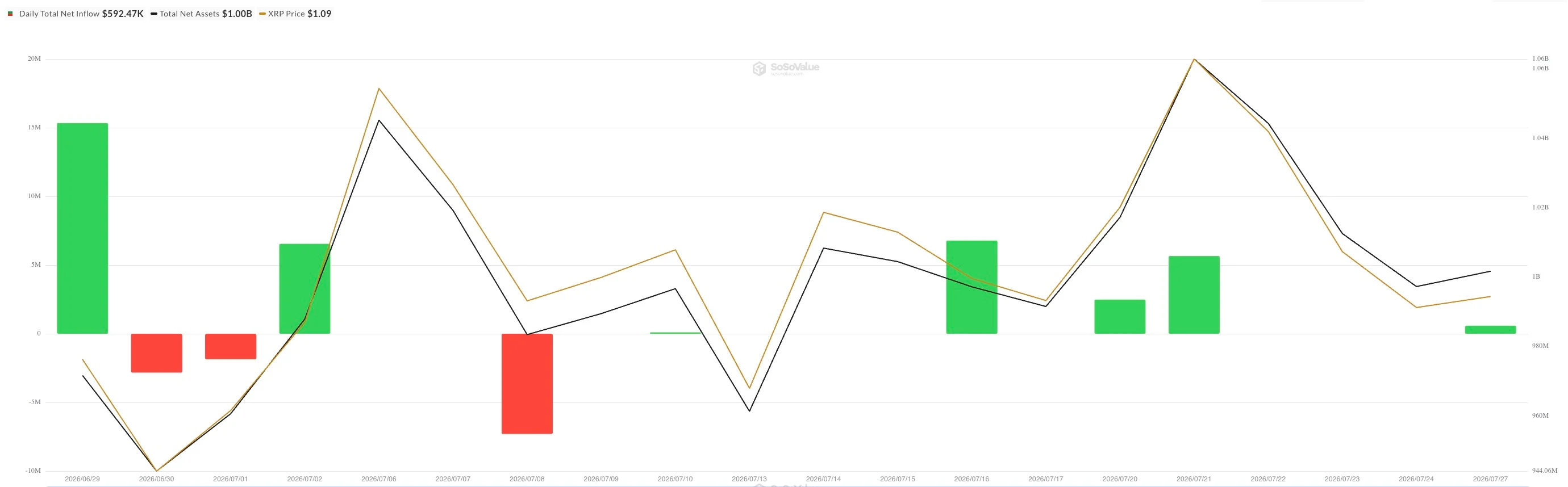
Nevertheless, even this modest and highly concentrated injection was enough for the sector to cross an important historical threshold. The total net assets held by U.S. XRP ETFs officially exceeded $1 billion once again. XRP, meanwhile, continues to hold near $1.09.
Observers link the renewed investor activity to the news surrounding the CLARITY Act. Although there is still considerable uncertainty around the final text of the bill, which is intended to bring long-awaited regulatory clarity to the U.S. digital asset industry, as well as the timeline for its passage, Franklin Templeton's leadership has already publicly expressed support for it.
Such positioning by a major financial institution appears to have acted as a green light for conservative investors. While the rest of the market remains on the sidelines and assesses the risks, Franklin Templeton's clients seem to have decided to move ahead of the curve through XRP, betting on an imminent resolution of the regulatory deadlock.
Billions of SHIB sent to the 'dead' address: Burn rate jumps 9,241%, but whales push price lower
SHIB's deflationary mechanism has had a record-breaking week, while traders have entered a period of local profit-taking. According to tracker Shibburn, the token burn rate surged by 9,241% over the past seven days, permanently removing an impressive 2.8 billion tokens from circulation.
However, this has not helped the price chart so far. SHIB has fallen 6.55% over the past 24 hours and is trading near $0.00000465. The market capitalization of Ethereum's largest meme cryptocurrency currently stands at $2.74 billion.
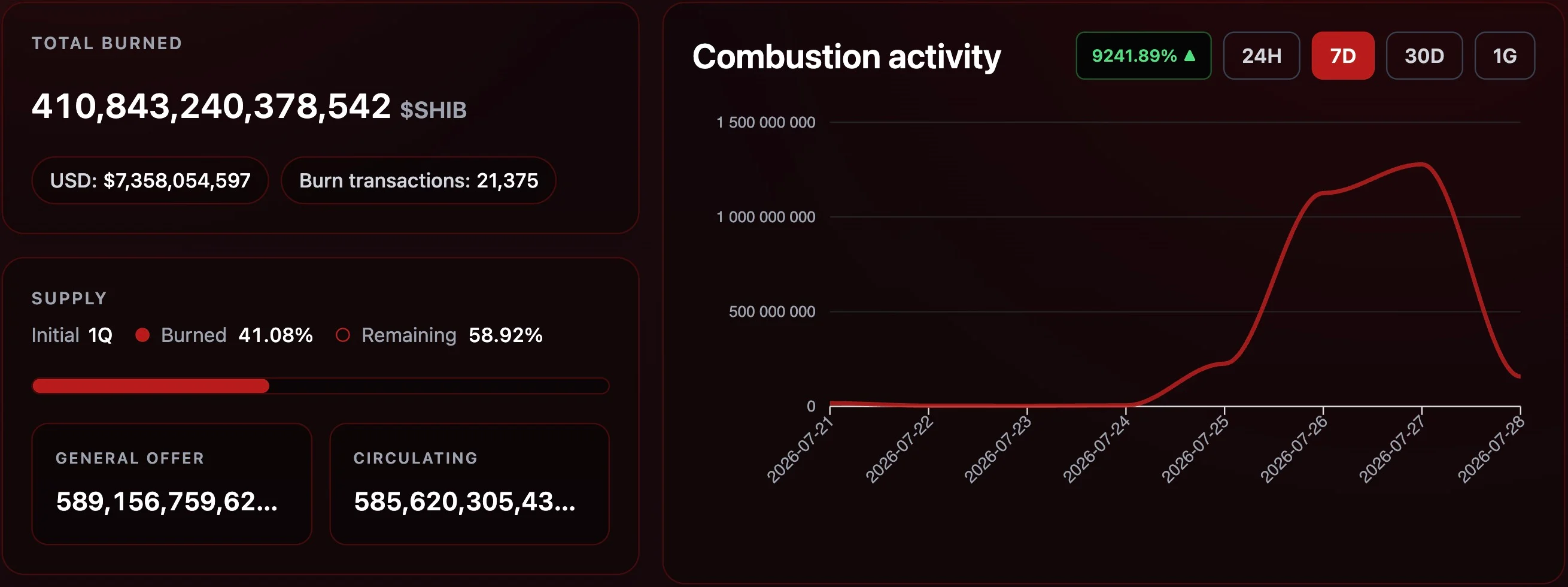
At the end of July, SHIB experienced a powerful rally to levels around $0.00000525, driven by large whales and Asian retail investors. The market has now entered a natural cooling phase, with short-term traders taking profits, while the daily burn rate has fallen by 81% to 344 million tokens over 24 hours.
SHIB's main challenge remains unchanged: its enormous total supply of 589 trillion tokens. Against this backdrop, even billion-token burns function more as a positive news catalyst than as a source of genuine scarcity.
Dollars instead of Dogecoin: Elon Musk debuts X Money
The long-awaited X Money payment system from social media platform X has officially launched in the United States, but contrary to years of expectations from the crypto community, it has turned out to be a conventional digital banking service.
Yesterday, the first Premium and Premium+ subscribers received access to peer-to-peer transfers, early salary payments and branded X Cards offering 3% cashback on purchases. The service offers an aggressive 6% annual yield on account balances and up to $10 million in FDIC insurance through a cash sweep system, all powered by traditional fiat payment rails from Visa and Cross River Bank.
Elon Musk summarized the launch in his typically concise style: "This is money." However, Dogecoin, the billionaire's favorite cryptocurrency, as well as Bitcoin, have been left out. Neither the X website nor the official announcements contain a single mention of cryptocurrencies.
The situation appears ironic, considering that Musk's other companies are deeply involved in digital assets. Tesla still holds 11,509 BTC on its balance sheet, while SpaceX holds 18,712 BTC. Together, this corporate crypto reserve of 30,221 BTC is currently valued at almost $2 billion, but even such holdings were not enough to bring cryptocurrency into X Money.
Against the backdrop of previous speculation about a crypto revolution inside the social network, the release looks like a pragmatic move. Instead of volatile tokens, Musk has chosen products that are familiar to mainstream users in order to compete directly with Venmo, PayPal and Cash App.
The integration of DOGE, BTC and other crypto assets, should it happen at all, has apparently been postponed until a later stage.
Crypto market outlook: Bitcoin turns defensive ahead of Fed rate decision
Bitcoin's local support at $63,800 is weakening as traders reduce risk ahead of the July 29 FOMC meeting, pricing in a 34%–40% probability of an unexpected Federal Reserve rate hike.
Against the backdrop of macroeconomic pressure and internal disputes within the Bitcoin network over the BIP-110 update, major players are shifting their focus toward preserving balance-sheet stability and selectively rotating capital into regulated altcoin funds, including ETH, SOL and XRP.
Key checkpoints:
- Bitcoin traders price in the risk of a hawkish Fed decision: Investors are reducing positions ahead of the July 29 meeting as the probability of an unexpected rate hike rises to 34%–40%, intensifying the market's local decline and expectations of increased volatility.
- U.S. spot BTC ETFs record net capital outflow: American Bitcoin funds ended their inflow streak with an $11.64 million outflow on July 27, while Ether, Solana and XRP funds recorded net inflows of $9.23 million, $1.03 million and $592,000, respectively.
- Strategy pauses BTC purchases to buy back shares: The company has not purchased cryptocurrency for five weeks and instead directed $25 million toward repurchasing its own shares at a discount. According to Benchmark analysts, the move will strengthen its balance sheet ahead of future rounds of Bitcoin accumulation.
- Miners minimize the risk of a Bitcoin network hard fork: Mining pools are largely ignoring the controversial BIP-110 proposal to restrict Ordinals and Runes protocols, refusing to move to a chain with a lower hash rate and no economic weight.
- Galaxy Digital diversifies into data centers: Mike Novogratz's company has signed a deal in Texas to build an AI campus with capacity starting at 74 MW by 2028, confirming the broader trend of repurposing crypto infrastructure for high-performance computing.