Author: Castle Labs
Translation: TechFlow
TechFlow Introduction: As on-chain finance increasingly resembles traditional markets, two fatal issues emerge: all fund flows are publicly visible, and quantum computing threatens existing cryptographic signatures. Bitcoin, as the largest asset occupying 56% of the crypto market, becomes the clearest litmus test for these two issues. Starknet's strkBTC solution attempts to address both visibility and durability: enabling private transfers of Bitcoin while preparing technically for the quantum era.
As on-chain finance gets closer to traditional markets, digital assets are facing higher standards and stricter requirements.
There are two key issues in this new world: on-chain fund flows are visible to everyone, and the cryptographic signatures underpinning the entire technology are threatened by quantum computing.
This is most evident with Bitcoin.
Bitcoin currently accounts for over 56% of the total crypto market cap and remains the anchor of the entire crypto market, despite having almost no programmability itself.
To enhance its utility and programmability, Bitcoin is exported across chains, entering the on-chain financial world through wrapped tokens.
But Bitcoin in DeFi needs more than just higher yields; it needs a way to transfer large amounts without public broadcast, and assurance that it will remain secure when tomorrow's quantum computers arrive.
The same applies to other assets in on-chain finance: assets need to be transferred, settled, and combined without exposing every position to the public, and cannot rely on cryptographic techniques that may not survive the next decade.
We have been tracking a protocol that seems to understand these issues earlier than most and builds solutions around both.
Although Starknet launched its BTCFi campaign earlier this year, it is not just about making Bitcoin available on-chain. It positions Bitcoin as the first clear test case for conditions that individuals and institutions truly care about: private by default, disclosable when necessary, and hardened for a post-quantum future.
Regarding the background of Starknet's work in this area, we have previously reported on why $2 trillion in Bitcoin sits idle, how Starknet's roadmap plans a path to trustless BTC, Starknet's new privacy framework STRK20, and why they design the system as "privacy through ownership."
Privacy and the Quantum Countdown
The core tenet of the crypto world has always been "don't trust, verify," which is exactly what transparent blockchains have allowed us to do. Verify balances, snoop on transfers, check fund flows, monitor contract interactions. Everything is open to everyone.
You can understand how this started.
Transparency builds trust, but full transparency harms intellectual property, strategies, personal safety, and operational privacy. This is especially true today, where AI-driven de-anonymization can link public addresses to real identities with up to 90% accuracy.
Privacy is not only a human right but also critical infrastructure needed for on-chain user protection and institutional adoption.
Individuals need privacy to avoid surveillance, profiling, harassment, crime, and political exposure. Institutions need privacy to ensure confidentiality of holdings, order flow, and other data, as well as to prevent counterparty visibility and strategy leakage. Additionally, privacy needs to be configurable for selective disclosure to auditors, regulators, or compliance departments.
Previous attempts at on-chain privacy have repeatedly highlighted trade-offs:
Fully anonymous privacy pools like Tornado Cash faced compliance pressure, leading to OFAC sanctions, as well as criminal charges and imprisonment for developers, vividly demonstrating that non-compliant paths are fraught with political and legal risks.
Native privacy coins (like Monero, Zcash) proved that hidden transactions are possible, but have struggled to integrate with the rest of the on-chain world, unable to compose with DeFi primitives at scale, pointing to a larger problem beyond privacy itself: liquidity, interoperability, and compliance issues.
Private execution systems like Aztec saw early demand for private DeFi, but they often faced high costs, liquidity fragmentation, and poor user experience.
The problems caused by lack of privacy are not limited to the isolated on-chain world but also permeate the physical world. On-chain addresses tied to real people and public balances bring higher risk of attack. CertiK reported 34 verified physical attacks against cryptocurrency holders in the first four months of 2026, a 41% year-over-year increase, representing only the recorded portion of these vastly underreported incidents. More specifically, in France, there were 41 crypto-related kidnappings from January to May 2026, averaging one every 2.5 days.
Privacy is not just about hiding transaction activity or protecting alpha; it is increasingly about reducing personal and operational risk.
While privacy issues are being actively addressed in the industry, another threat from quantum computing has emerged. A path that simultaneously addresses visibility and durability can push blockchain closer to becoming the next-generation financial infrastructure.
In March of this year, a report from Google Quantum AI, co-authored by Justin Drake (Ethereum Foundation) and Dan Boneh (Stanford University), identified multiple attack vectors and estimated that approximately $100 billion in the Ethereum ecosystem is at risk. It also specifically noted that Starknet has a stronger post-quantum position than other major L2s because its proof system is based on hash-based STARK assumptions rather than elliptic curve cryptography.
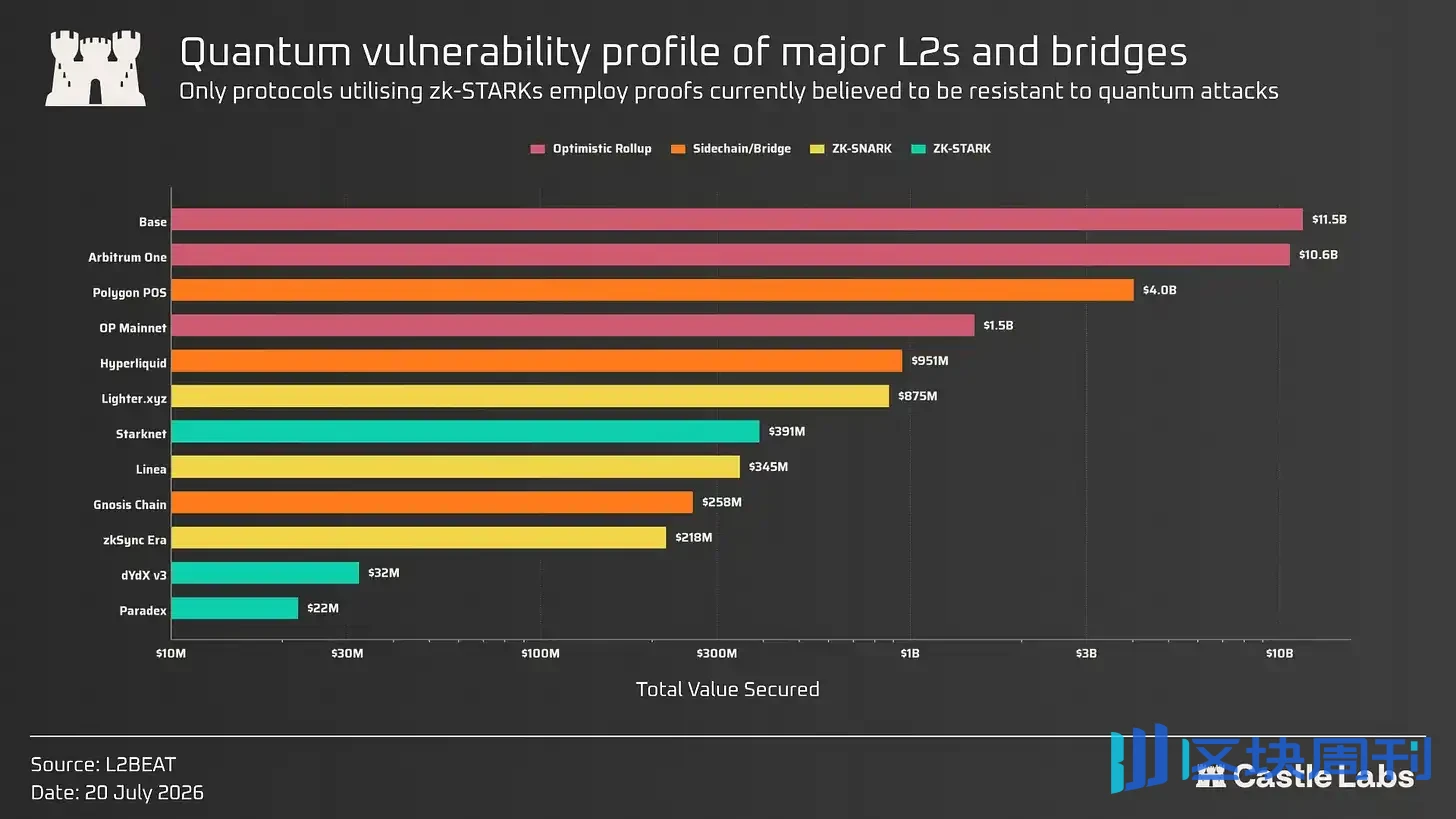
The paper focused on secp256k1 public key exposure, relevant to Bitcoin and Ethereum wallets, stating that a sufficiently powerful quantum computer could attack a wallet in less than 9 minutes. Justin Drake later warned that there is "at least a 10% chance" that a quantum computer could recover private keys from exposed public keys by 2032.
While this is not yet a reality, the long-term security and lifespan of assets that are supposed to be held for decades have been called into question.
Bitcoin is the world's most important digital asset, and as it increasingly serves as collateral, reserves, and assets on institutional balance sheets, its security and privacy requirements are rising.
In the next section, we highlight a solution developed around Bitcoin, the largest and clearest test case for these privacy challenges.
strkBTC: Private Bitcoin on Starknet
We have probably all used BTC wrapped tokens. They bring Bitcoin into other ecosystems and make it composable: as a tradable asset, as collateral, as liquidity.
What they do not solve is visibility.
While wrapped BTC can become productive, every move can still be monitored, inspected, and traded against by counterparties. Deposits, loans, trades, LP positions, repayments, withdrawals, wallet clusters, treasury flows. All public by default.
This is not how serious financial markets operate, and until this is solved, on-chain finance will continue to hit an institutional ceiling.
In traditional finance, privacy is built into the infrastructure, whether you are a retail investor or an institutional giant. In fact, a large portion of stock trading volume flows through private or over-the-counter venues such as dark pools, where counterparties see what they need to see, regulators retain access when needed, and the public sees aggregated volume rather than every real-time move.
Cryptocurrency treats visibility as the norm. In reality, privacy should be the norm.
strkBTC is Starknet's attempt to let Bitcoin flow in the on-chain financial world without this limitation.
strkBTC is an ERC-20 on Starknet, backed by BTC locked on the Bitcoin network, and built on StarkWare's privacy framework STRK20 for shielding balances and private transfers.
STRK20 provides two modes for strkBTC:
In public mode, it behaves like a standard ERC-20: users can hold, transfer, supply to lending markets, provide liquidity, or use as collateral.
In shielded mode, selected balances and transfers are hidden from public view. Users can shield, transact privately, and unshield back to public balance directly from their wallet.
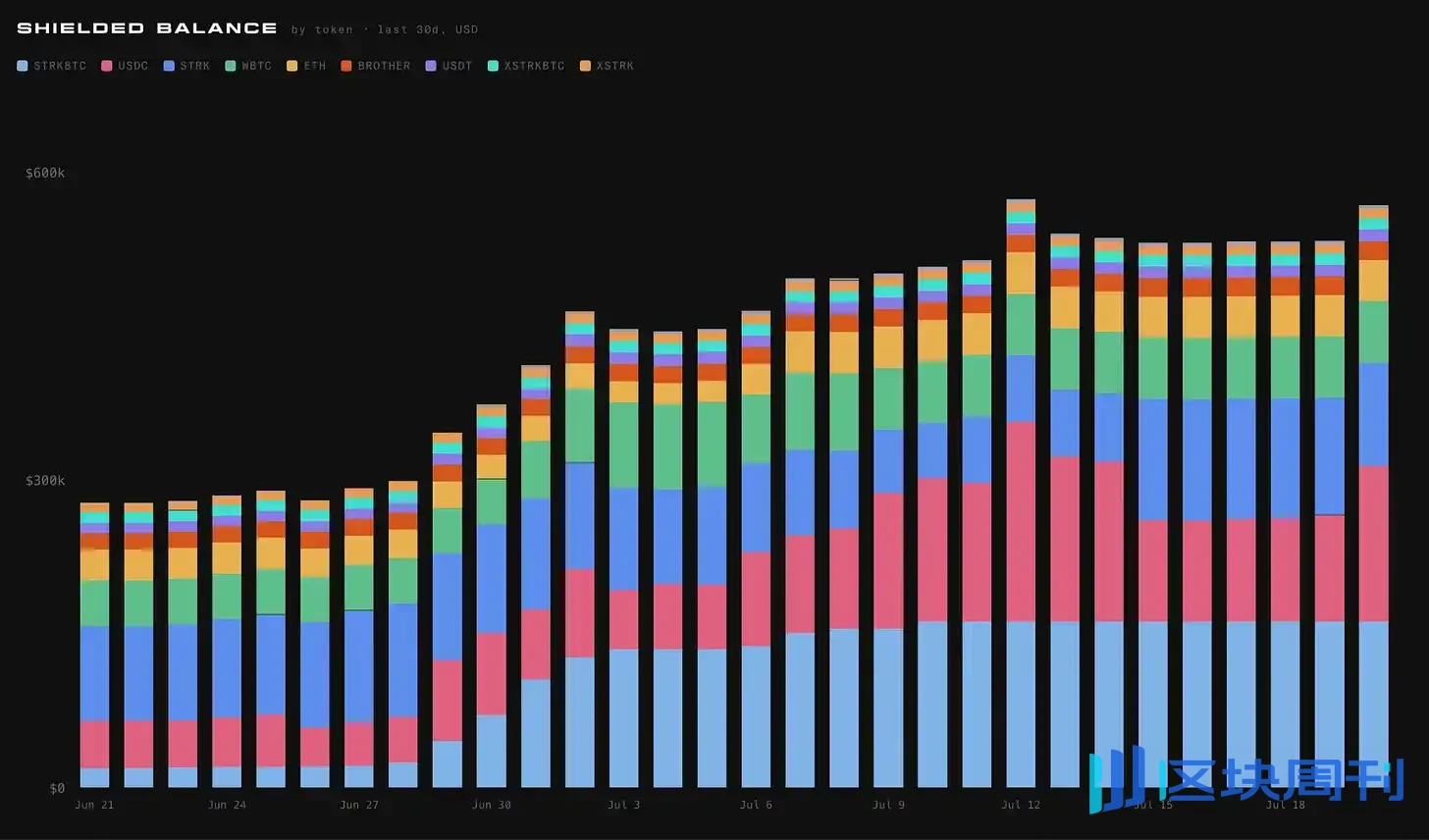
Before the Starknet v0.14.2 upgrade, which enables STRK20, applications that wanted to verify STARK proofs on Starknet had to do so within a smart contract, which was costly and complex due to the size of the proofs. But now, transactions can directly reference off-chain proofs, and Starknet consensus handles verification natively through in-protocol proof verification.
This unlocks privacy at the protocol level, rather than the historical friction of using separate applications, chains, pools, or mixers, which add complexity, cost, and liquidity fragmentation. This allows applications to focus on building better products, as the underlying infrastructure makes private operations easily accessible to builders.
Compliance is a key part of the design, which is part of opening Starknet to institutions coming on-chain.
When a user shields strkBTC, the associated viewing key is shared with Financial Privacy Inc (also known as FPI), an independent third-party auditor operating compliance infrastructure for STRK20, granting it scoped access in the event of a valid regulatory request. While this may not align with pure cypherpunk philosophy, it aligns much more closely with traditional markets. Privacy from the public, disclosure to regulators.
The bridge follows a similar logic, operated by a trusted strkBTC consortium consisting of Twinstake, NEAR Intents, Luganodes, UTXO Management, and Xverse. Currently, these independent signers support minting and burning between BTC and strkBTC. The consortium is not the final state; however, Starknet is committed to a progressive hardening roadmap over time.
strkBTC is not about being just another wrapped token, but about unlocking the potential of a programmable, composable BTC whose movements are not broadcast, thus solving the first problem: visibility.
The next problem is persistence.
Blockchain's Quantum Problem
Every blockchain relies on public-key cryptography. When a user signs a transaction, they reveal the public key while keeping the private key hidden. This is routine in Bitcoin and most other blockchains, considered perfectly normal and secure in today's environment. But in a post-quantum world, this assumption becomes a bit shaky.
As mentioned earlier, a sufficiently powerful quantum computer running Shor's algorithm could theoretically derive the private key from an exposed public key. This means that public key exposure, the harmless part of transaction verification, could soon become a potential attack surface. This is not unique to any one chain, as the same elliptic curve foundation underlies Bitcoin, Ethereum, and Solana.
The threat is shared, but the ability to respond is not. The most exposed chains are often the slowest to move, and Bitcoin is the clearest example.
Bitcoin does not lack ideas for a post-quantum future. If anything, it has too many ideas. The problem is agreeing on the trade-offs the network is willing to accept: larger signatures, higher costs, legacy coin handling, user migration, wallet support, miner policies, or battles over freezing dormant and unmigrated coins.
Clearly, Bitcoin's problem is both technical and social-political.
Dan Boneh, one of the co-authors of the Google paper, calmed everyone down in a recent interview: "Bitcoin should not panic, but it cannot ignore this either. Moving too fast could be worse than waiting, because a rushed post-quantum migration could introduce catastrophic errors before quantum becomes a live threat."
Bitcoin may solve its quantum problem, but not quickly or cleanly.
This slowness is partly a feature of sound money, but it also leaves the door open. While the base layer debates, more agile stacks can build the persistence that Bitcoin itself cannot yet promise.
Ethereum and its extended L2s do not escape this problem. Most rollups settle to Ethereum and rely on it for data availability, thus inheriting the base layer's exposure. Ethereum is aware of this and has published its own multi-year migration plan, but until the plan arrives, every chain built on it is exposed to Ethereum's post-quantum migration issues.
This is where Starknet leads. While it settles to Ethereum like any other L2, Starknet's core, its proving layer, is built on foundations that do not rely on quantum-vulnerable cryptography. Although the inherited exposure from Ethereum is real, everything within Starknet's own stack carries less migration debt than most major chains, and it has more in the pipeline.
Architectural Advantage
Starknet's advantageous position stems from two design choices, both made before quantum computing became an urgent issue.
The first is the proving layer, the system that generates STARK proofs to secure every state transition on the network. It relies on hash functions, not the elliptic curve math that quantum computers threaten, a design established since a 2018 paper co-authored by StarkWare CEO Eli Ben-Sasson. This is the critical security layer, and it is why the Google paper listed Starknet as the only major L2 already ahead.
The second is native account abstraction. On most chains, the signature scheme is fixed at the protocol level, so replacing it requires a hard fork, and every user and application must follow. Starknet, however, lets accounts define how they verify identity themselves, so users can migrate to quantum-resistant signatures without changing the protocol layer. According to StarkWare, a quantum-resistant wallet S2morrow has already been deployed using Falcon-512, and OpenZeppelin is building a standardized version.
On many chains, such a change means coordinating a full protocol migration. On Starknet, most of the work can start with wallet upgrades. This does not mean every Starknet wallet is quantum-resistant, but the model provides an easier path for Starknet users.
StarkWare is now filling the remaining gaps. Last week they released a roadmap to make Starknet end-to-end quantum-safe before Q-day. Q-day is the point when a quantum computer is powerful enough to break today's cryptography.
The roadmap is divided into three phases:
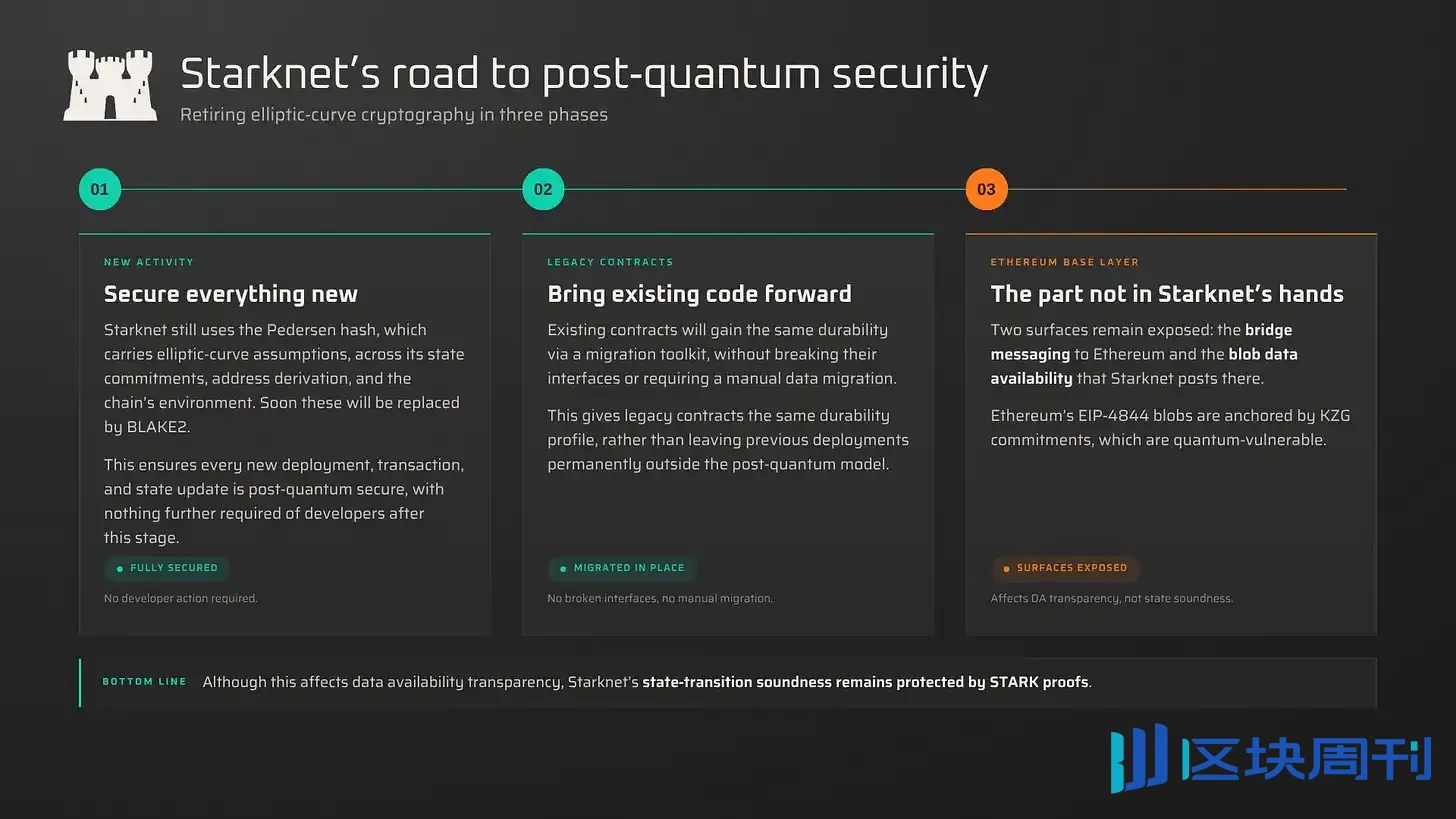
None of this means Starknet is fully quantum-resistant today, and the roadmap does not claim so.
What Else Needs to Be Proven?
Starknet can replace Pedersen with BLAKE2, improve quantum-resistant wallet support, and provide migration paths for legacy contracts, but it cannot eliminate all inherited issues from the base layer. Bridged messages and blob data availability still rely on Ethereum's own quantum-resistant roadmap. Starknet can harden the parts it controls, but the parts inherited from Ethereum will advance on Ethereum's timeline. That said, the Ethereum Foundation has outlined structured fork milestones, aiming to complete core quantum-resistant infrastructure around 2029.
strkBTC has a similar phased story. Currently, bridging relies on a federation to coordinate the minting and burning between BTC and strkBTC. This is a trusted starting point, but not the ideal trustless final state. Starknet's goal is to move from a federation model to Bitcoin-native verification, then to a less-trusted BitVM design, and finally to a fully trustless OP_CAT-based design if Bitcoin enables the required opcodes in the future.
View keys are another yet-to-be-proven component. They are Starknet's practical answer to institutional privacy: publicly opaque but selectively disclosable, but they have not yet been stress-tested in real-world scenarios, raising questions about who can request disclosure, under what conditions, and with what safeguards.
Digital assets, including Bitcoin, do not need another wrapper. They need the surrounding infrastructure to operate on-chain without compromising the two things institutions care about most: confidentiality in the present and durability in the future.
strkBTC addresses confidentiality by providing a private, selectively disclosable path for BTC into DeFi. Starknet's existing architecture and roadmap target durability: its proving layer already avoids the elliptic curve assumptions that burden other protocols with quantum migration, and its roadmap now extends this advantage to the remaining components, with the explicit goal of making Starknet quantum-safe before "Q-day."
While the results are still early, the direction is clear: the next institutional phase of on-chain finance requires more than just yield. It requires privacy, compliance, programmability, and durability all integrated into the same tech stack.
Disclaimer: The information provided in this article is not trading advice. BlockWeeks.com is not responsible for any investments made based on the information provided in this article. We strongly recommend conducting independent research or consulting qualified professionals before making any investment decisions.