Author: Nancy, PANews
Who would have thought that in just over 7 months of 2026, the Korean stock market would trigger circuit breakers 8 times, setting a rare volatility record in the history of Korea's capital market. Especially in the past two months, circuit breaker alarms have been frequently sounded, with repeated sharp declines continuously shaking investor confidence.
This summer's Korean stocks are destined to be an unforgettable memory for countless investors.
From the world's strongest stock market to eight circuit breakers, the memory duopoly drags down the market
The Korean stock market has triggered a circuit breaker again.
On July 28, the Korea Composite Stock Price Index (KOSPI) suffered a sharp decline, plunging more than 11% during the session, triggering the market's circuit breaker mechanism. This is also the first time the index has fallen below 6,000 points since April 14, with a cumulative decline of more than 35% from the stage high set in June.
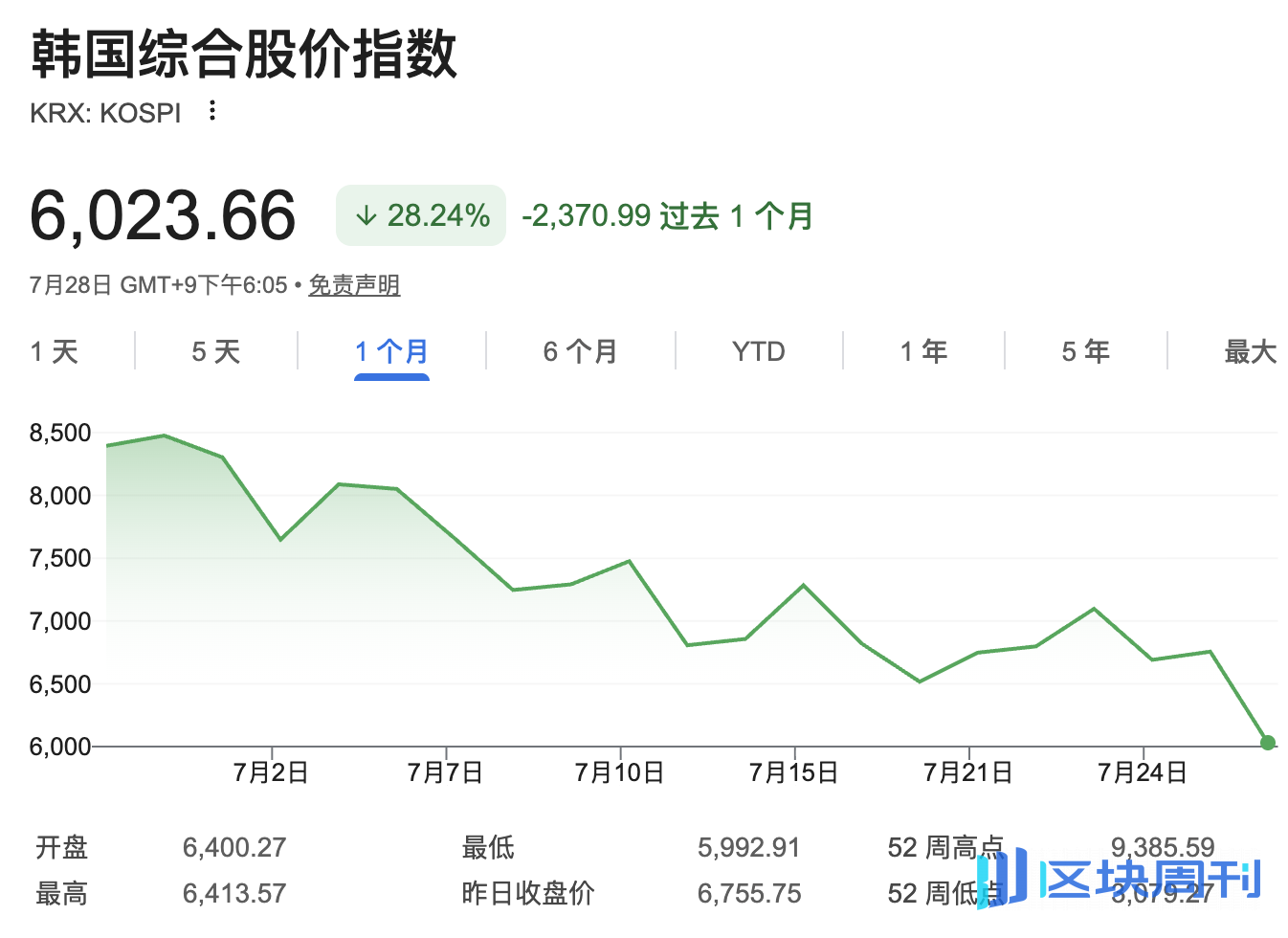
This is the eighth time the Korean stock market has triggered a circuit breaker this year.
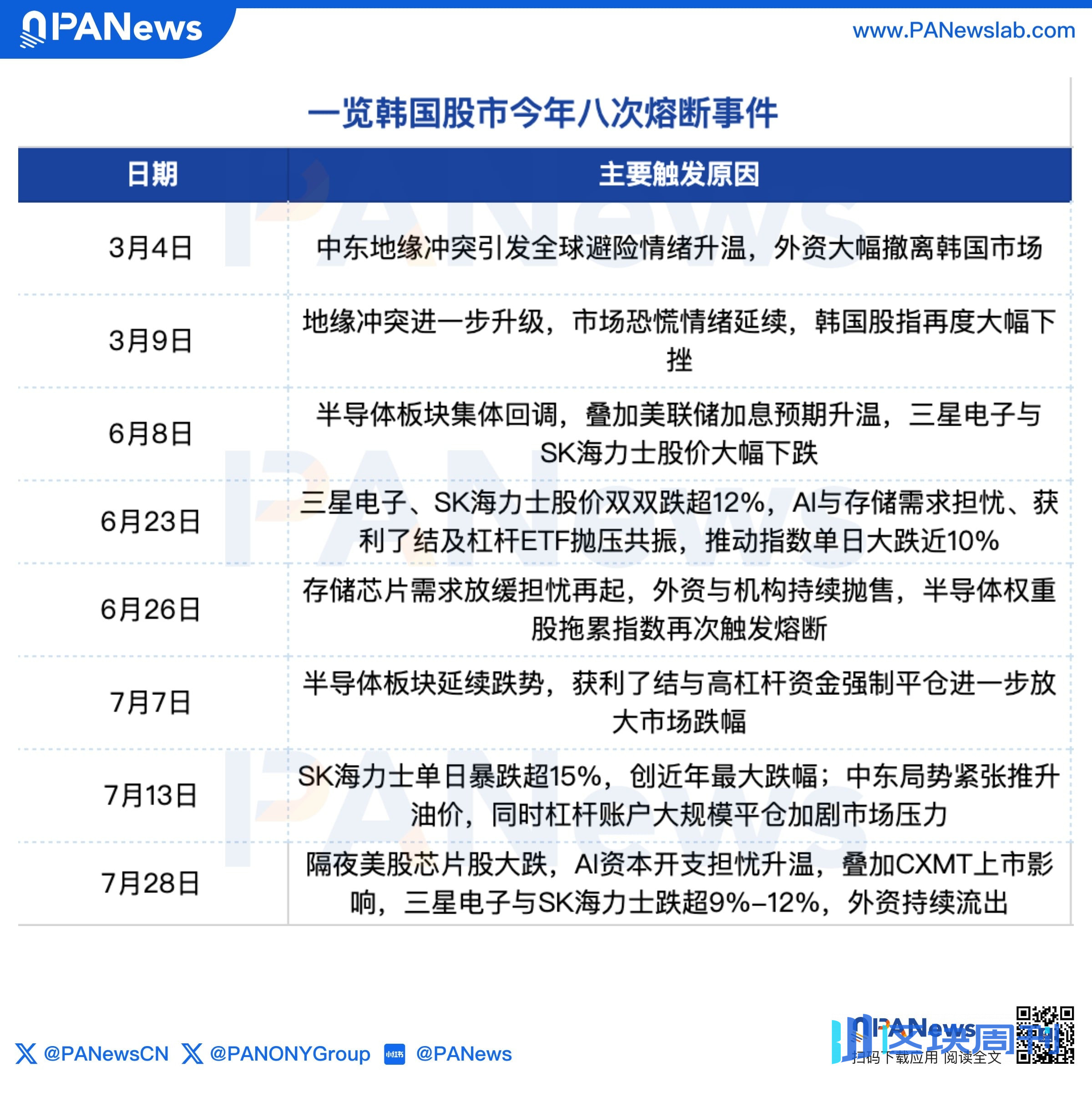
If the two circuit breakers in March were mainly affected by the escalation of geopolitical conflicts in the Middle East and the rise in global risk aversion, then the six consecutive circuit breakers since June have exposed more of the structural risks accumulated in the Korean stock market itself. Among them, the sharp adjustment in the semiconductor sector has become a key factor crushing market confidence.
The biggest driving force behind this round of Korean stock market gains came from the AI boom, and now the market is suffering the backlash from the AI cooldown. In particular, the heavy losses of Samsung Electronics and SK Hynix have become key factors dragging down the market.
These two semiconductor giants once accounted for more than 60% of the KOSPI index weight, contributed most of the previous gains in the Korean stock market, and helped the Korean market become one of the best-performing markets globally. However, at the same time, the market's high dependence on the semiconductor sector has also amplified the vulnerability of the Korean stock market.
Now, as the market begins to reassess the sustainability of AI capital expenditure, the growth potential of high-end memory chip demand, and future supply pressure changes, Samsung Electronics and SK Hynix are the first to be impacted.
In the past month, Samsung Electronics has fallen about 31.2%, SK Hynix has fallen more than 14.8%, and SK Hynix's overseas depositary receipts (ADR) even fell below the issue price less than a month after listing.
To some extent, the Korean stock market is experiencing "success due to semiconductors, failure due to semiconductors."
Hynix on-chain contract flash crash, $867 order triggers Hyperliquid liquidation storm
While the SK Hynix spot market experienced violent fluctuations, the on-chain perpetual contract market also saw an abnormal "wick."
According to HyperInsight monitoring, at 7:00 Beijing time today, the price of the SKHX perpetual contract on the Hyperliquid platform suddenly dropped from 1128.2 dollars to 927 dollars, a short-term decline of 17.9%, triggering a large number of high-leverage long position liquidations.

Data shows that the open interest notional value of the contract plummeted from about 508 million dollars to 388 million dollars, with long liquidation volume reaching nearly 80 million dollars within 4 hours, even exceeding the Binance market during the same period.
The direct trigger of this flash crash was an abnormal order worth only about 867 dollars in the Korean NXT pre-market. Due to low liquidity in pre-market trading, this small order, which fully complied with trading rules, unexpectedly became an important source of external price data and was adopted by the Trade.XYZ oracle system.
Subsequently, the mark price of the SK Hynix perpetual contract on Hyperliquid adjusted accordingly. In a high-leverage derivatives market, a temporary deviation in the mark price can trigger large-scale liquidations. As long positions were forced to close, selling pressure further amplified, eventually forming a chain reaction.
In contrast, the impact on the Binance market was relatively limited. Before the opening of the main Korean market, Binance still mainly used internal price mechanisms and did not immediately switch to external quotes, thus avoiding a similar scale of cascading liquidations. However, due to arbitrage trading between markets, the SK Hynix perpetual contract price was still affected and experienced a synchronized decline.
This incident was not market manipulation, but rather a butterfly effect triggered by insufficient liquidity, external price input mechanisms, and high leverage.
In a mature spot market, a transaction of less than a thousand dollars usually has little impact. But in on-chain derivatives markets that rely on external price inputs, small transactions can affect the mark price through the oracle mechanism and further transmit to large leveraged positions.
Afterwards, Hyperliquid responded that the SKHYNIX perpetual contract was deployed and operated by the Trade.xyz team, and the relevant team is investigating the cause of the incident and will update progress after completing the analysis.
Regarding the HIP-3 market mechanism, Hyperliquid explained that the deployer is responsible for pushing the mark price, oracle, and external price input of its market, and can adopt a mark price method similar to that of perpetual contracts operated by validators, i.e., the protocol contributes one of three median components, and the other two components are pushed by the deployer and affect the final mark price. For example, if the on-chain (last traded price, best bid, best ask) median is 100, and the deployer pushes 150 and 151, then the mark price will be 150.
And this cascading liquidation triggered by a small transaction once again reminds the market that as the on-chain derivatives market continues to expand, the stability of price sources, oracle design, and liquidation protection mechanisms under extreme market conditions are becoming issues that the on-chain market must face.
Korean stock market faces confidence crisis, regulators step in to "put out the fire"
The "Black July" of the Korean stock market continues, with market confidence severely damaged and regulators beginning to accelerate intervention.
Among them, the prevalent leveraged trading among Korean retail investors has become an important amplifier of this market volatility. According to data previously disclosed by Korean authorities, as of July 13, the cumulative forced liquidation volume in July reached 344.2 billion won, with more than 1.2 million leveraged retail investor accounts hitting margin call lines, of which about 320,000 to 360,000 accounts have been forcibly liquidated by brokerages, and some investors even owe money to brokerages.
To this end, Kim Eun-hye, a lawmaker from the People Power Party of South Korea, is currently discussing whether to file a state compensation lawsuit against the government for related investor losses. Fellow party lawmaker Na Kyung-won also publicly advocated for a comprehensive investigation into national losses and actively considered state compensation, proposing to uncover the process of "hasty introduction" by the Blue House and financial authorities through a parliamentary investigation and special counsel.
At the same time, facing expanding risks, the Financial Services Commission (FSC) of South Korea has begun tightening regulations on single-stock leveraged products. According to the new rules, from July 31, 2026, the basic margin threshold for individual ordinary investors to invest in related products will be raised from 10 million won to 30 million won, while further improving margin calculation rules to reduce the impact of retail investors using leverage to chase gains and cut losses on the market. The regulator also indicated that it may further raise investment thresholds and set limits on individual investment amounts in the future.
In addition to leveraged ETFs, the FOMO sentiment of South Korean retail investors borrowing money to trade stocks is also amplifying market risks. Stimulated by the rising market, a large number of investors are chasing stock market returns through loans, and the loan quota of South Korean banks once flashed red in the middle of this year. At the same time, some investors with poor credit conditions have begun to turn to illegal private lending, with the size of the relevant group growing from 59,000 people last year to 119,000 people.
To reduce financial risks, South Korean banks have recently tightened credit loan policies, and the financial regulator is also considering restricting the use of borrowed funds to invest in high-risk financial products, for example, stipulating that among the funds invested in financial products, at most 20% can be used for single-stock leveraged products.
As the South Korean stock market has taken a "roller coaster" ride, foreign capital is also accelerating its withdrawal. A recent report on South Korean stock market strategy by JPMorgan pointed out that foreign capital net outflow from the South Korean stock market has exceeded $110 billion this year, setting a record for the largest outflow in a single Asian market. About 90% of this is concentrated in Samsung Electronics and SK Hynix.
The decline in market confidence has also prompted South Korean investors to turn to overseas markets again. According to the Seoul Economic Daily, the net purchase of US stocks this month exceeded 5 trillion won. According to data from the Securities Information Portal Seibro of the Korea Securities Depository, from the 1st to the 27th of this month, the net purchase of US stocks by domestic investors in South Korea was close to $3.59 billion, about 5.5 times the net purchase amount for the entire month of June, with funds mainly flowing into the semiconductor and technology stock sectors.
From a global star market under the AI cycle dividend to the current continuous circuit breakers, leverage clearance, and foreign capital withdrawal, the South Korean stock market is currently undergoing a brutal but necessary repricing.